
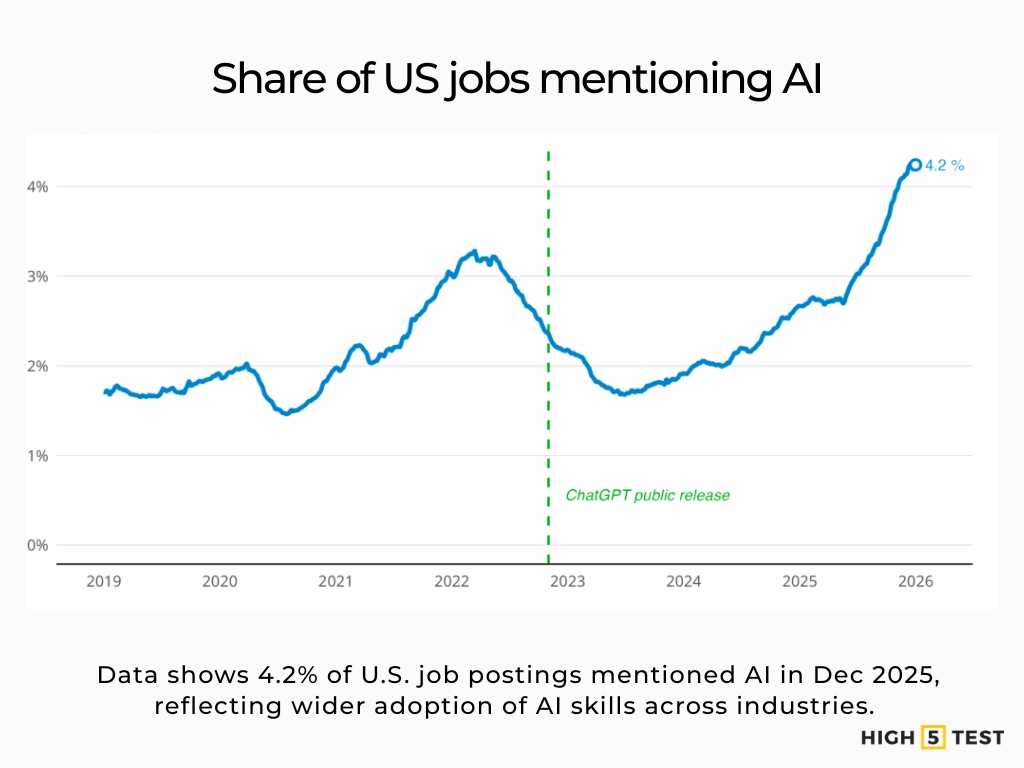
Artificial intelligence is rapidly transforming job creation in the United States, with measurable impacts across hiring, skills, and wages in 2025 and 2026. By December 2025, 4.2% of all U.S. job postings mentioned AI, reflecting a surge of over 130% since 2020, which signals that AI is becoming a standard requirement across industries—not just a niche technical skill.
At the same time, AI-specific roles are steadily increasing, with postings requiring AI skills rising from 1.4% in 2023 to 1.8% in 2024, while AI-driven sectors are seeing faster wage growth, including 16.7% increases in computer systems design versus 7.5% nationally.
These trends show that AI job creation is not only growing, it is also fundamentally reshaping how work is defined and valued.
10 most interesting AI job growth statistics
- Around 119,900 AI-related roles were added in 2024, showing that AI is already creating significantly more jobs than it is eliminating at this stage.
- Only ~55,000 jobs were linked to AI-related cuts through 2025, meaning job creation currently outweighs displacement by more than 2:1.
- Over 75% of AI-related job cuts happened after 2023, indicating that disruption is accelerating but still relatively early-stage.
- AI can technically perform work equivalent to ~11.7% of U.S. jobs, highlighting a large future automation ceiling that hasn’t yet fully translated into real job losses.
- 66% of enterprises are reducing entry-level hiring due to AI, signaling a major structural shift where AI is replacing junior roles rather than entire professions.
- 51% of American workers worry AI will replace their jobs by 2026, showing that perceived risk is much higher than actual measured displacement so far.
- 91% of roles in enterprises have already changed or been impacted by automation, proving that AI’s biggest effect is transformation, not outright job elimination.
- AI-driven job creation already exceeds AI-related job losses, confirming that the net employment effect of AI (so far) is positive.
- Displacement from AI remains a small share of total labor turnover, indicating that macro-level labor market disruption is still limited despite rapid technological progress.
- AI is shifting hiring patterns rather than reducing total employment, with companies reallocating demand toward AI-skilled roles and away from routine positions.
15+ Statistics on AI job growth across the U.S. labor market (2025-2026)
About 4.2% of U.S. job postings mentioned AI in December 2025. This level shows that AI tools and skills now appear in many sectors rather than remaining limited to technology companies.
Source: Hiring Lab
AI postings grew 130%+ since early 2020, showing that AI labor demand has expanded more than twenty times faster than overall job postings growth (~6%).
Source: Hiring Lab
Listings that require AI skills rose from 1.4% in 2023 to 1.8% in 2024. This increase shows that employers now treat AI expertise as a defined job requirement rather than an optional skill.
Source: Stanford University – Human-Centered Artificial Intelligence
Statistics on how generative AI is driving new job demand
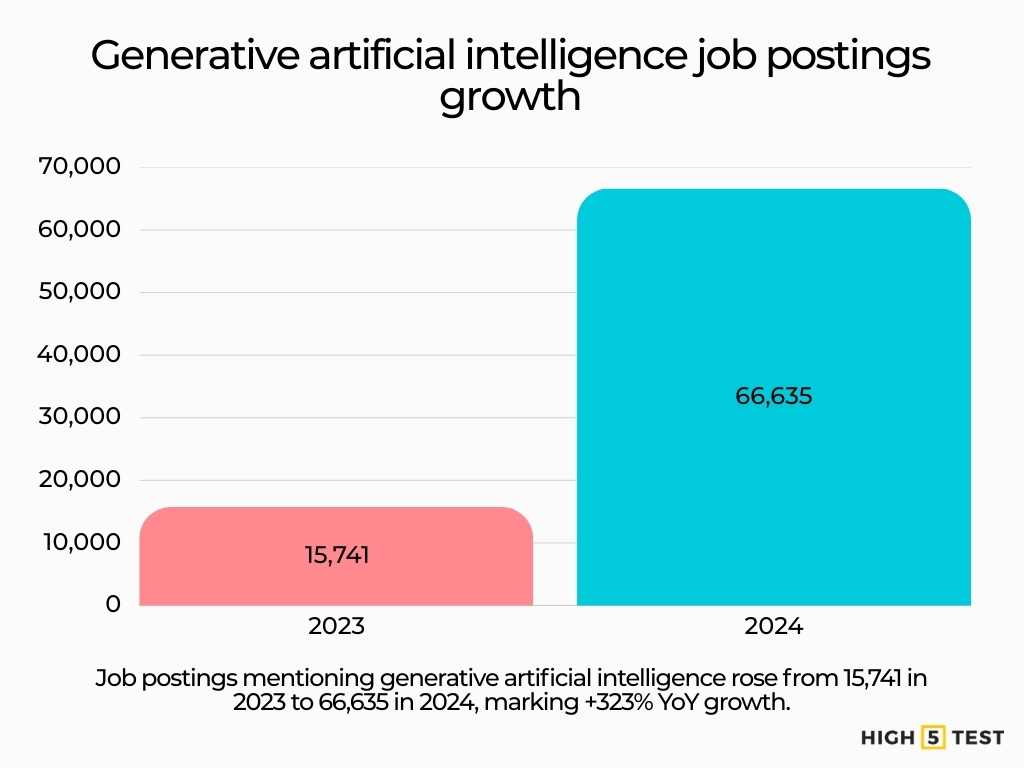
Generative AI has produced a sharp rise in demand for specific technical skills. Job postings that mention generative AI increased more than three times year over year from 2023 to 2024.
Source: Stanford University – Human-Centered Artificial Intelligence
Mentions of “Generative artificial intelligence” reached 66,635 postings in 2024 (+323% YoY), indicating explosive employer demand for GenAI-specific capabilities.
Source: Stanford University – Human-Centered Artificial Intelligence
Research also shows limited full job replacement from generative AI. Only 0.7% of job skills fall into the category most likely to be replaced by GenAI. Most changes involve task adjustments inside existing roles.
Source: Hiring Lab
Data on top industries driving AI employment growth
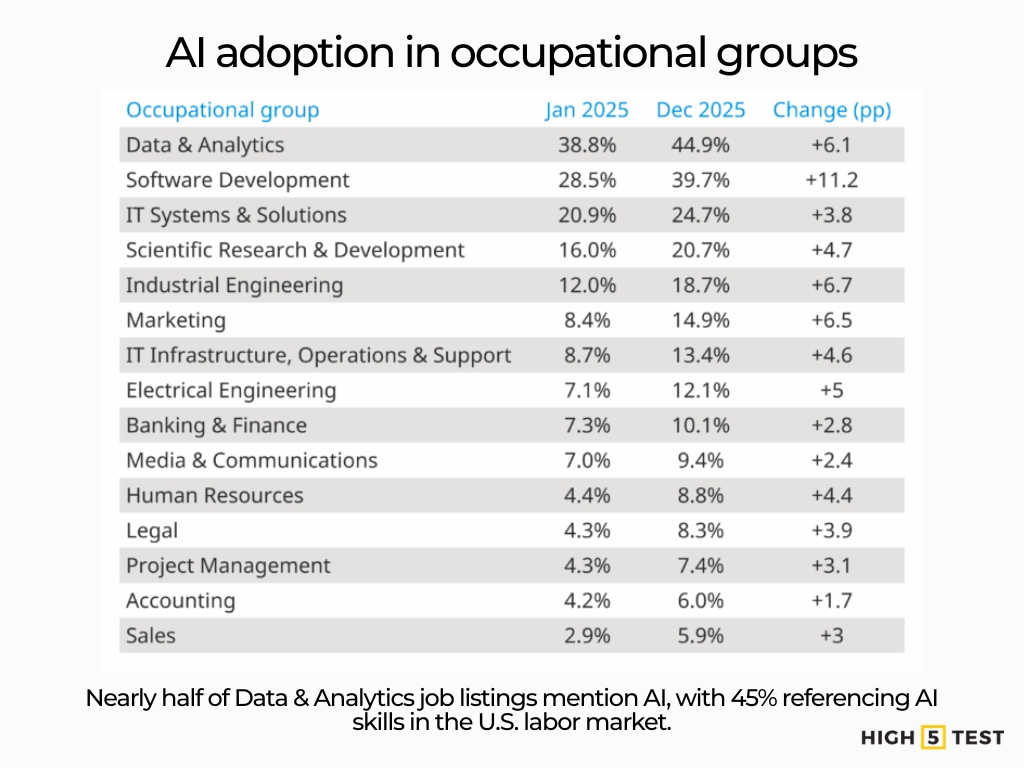
Some industries show stronger integration of AI tools and skills. 45% of Data & Analytics postings mention AI, showing that analytics is now one of the most AI-integrated job families in the U.S. labor market.
Source: Hiring Lab
Software development, IT systems, and scientific research positions also show strong adoption. More than 20% of postings in these fields mention AI capabilities.
Source: Hiring Lab
The top 10% most AI-exposed industries experienced 8.5% wage growth since fall 2022. These sectors compete strongly for workers who can build, manage, or apply AI systems.
Source: Federal Reserve Bank of Dallas
Statistics and income insights in AI-related careers
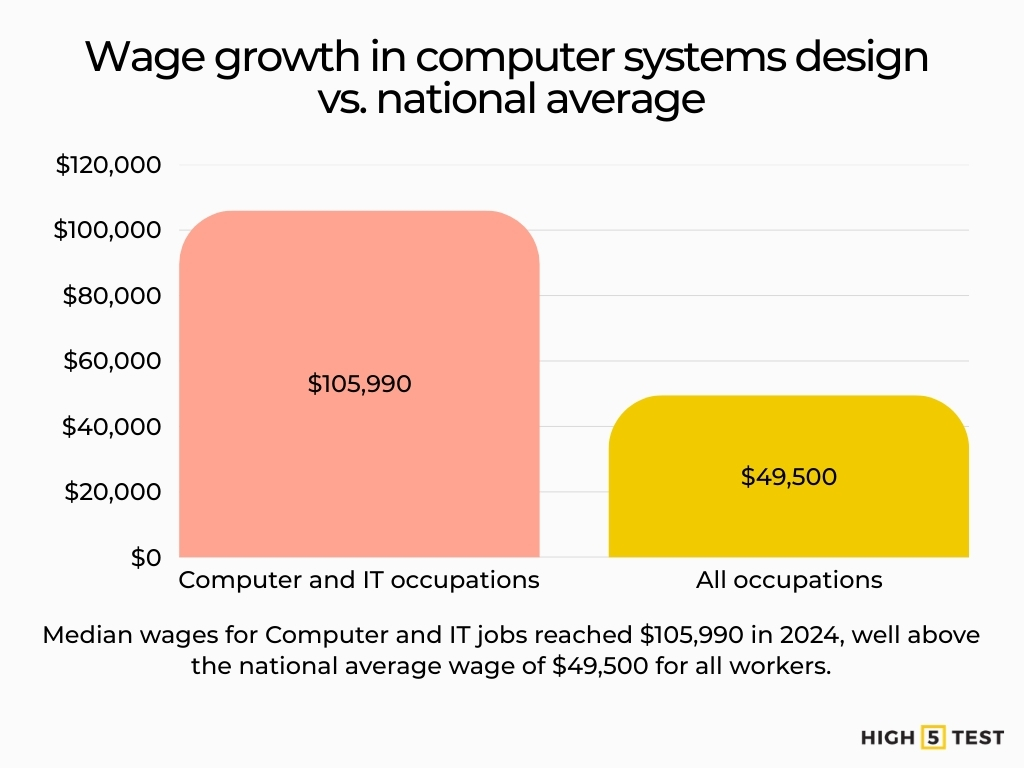
Wage growth reflects demand for technical talent connected to AI. Computer systems design wages rose 16.7% since fall 2022 versus 7.5% nationally, reinforcing that AI-driven sectors are outperforming the broader labor market.
Source: Federal Reserve Bank of Dallas
The median annual wage for computer and IT occupations reached $105,990 in May 2024. This level stands well above the national median for all occupations.
Source: U.S. Bureau of Labor Statistics
Data on how AI is reshaping job responsibilities
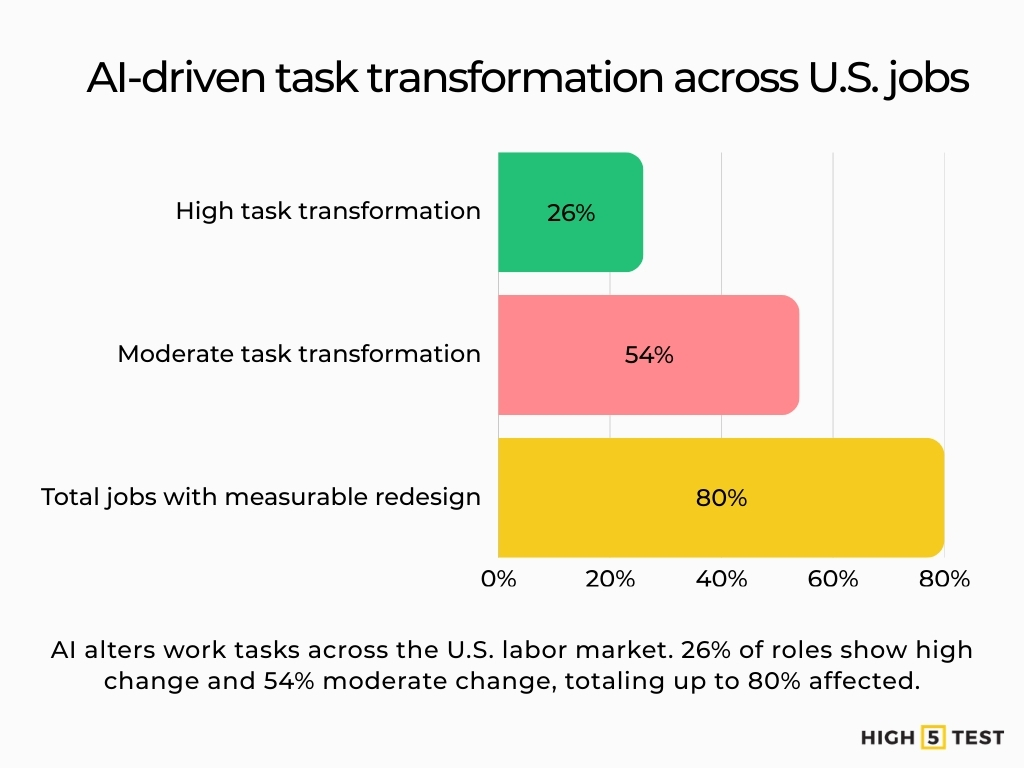
Most labor market changes linked to AI involve task adjustments rather than full job replacement. Research estimates that 26% of roles show high levels of task transformation and 54% show moderate levels of change, meaning up to 80% of U.S. jobs may experience measurable AI-driven task redesign.
Source: Hiring Lab
AI skill demand rising from 1.4% to 1.8% of postings indicates a gradual but durable expansion of dedicated AI expertise roles.
Source: Stanford University – Human-Centered Artificial Intelligence
Long-term projections show significant job turnover tied to technology adoption. 92 million jobs may disappear by 2030, while 170 million new roles may appear. This shift produces a net gain of 78 million jobs.
Source: World Economic Forum
Conclusion
The latest data confirms that AI job creation in the U.S. is driven primarily by skill integration and workforce transformation, rather than just the emergence of new job titles. With 4.2% of postings already mentioning AI and rising demand for specialized AI skills, AI capabilities are becoming embedded across nearly all knowledge-based roles.
At the same time, higher wage growth in AI-exposed industries, such as the 16.7% increase in computer systems design wages since 2022, highlights strong and sustained demand for AI talent. The key takeaway is clear: AI is not simply creating jobs; it is redefining them, and long-term career growth increasingly depends on AI-driven skills and adaptability.
FAQ
How many AI-related jobs appeared in 2025?
A single official count does not exist. Labor market indicators show strong growth. About 4.2% of U.S. job postings mentioned AI in December 2025, and postings with AI references have grown more than 130% since 2020.
What percentage of U.S. jobs require AI skills?
Research from the Stanford AI Index reports that 1.8% of job postings required AI skills in 2024, up from 1.4 percent in 2023.
Which job functions show the highest AI adoption?
Data and analytics positions lead adoption. Around 45% of job postings in this field mention AI.
Are AI-related sectors experiencing higher wage growth?
Yes. Computer systems design wages rose 16.7% since fall 2022, while national wage growth across all occupations reached 7.5% during the same period.