
Registered apprenticeship participation in the United States kept rising in 2024 and 2025. Recent totals show about 680,000 active registered apprentices nationwide. Programs have also expanded beyond construction into manufacturing, healthcare, IT, and transportation.
Even with this growth, apprentices still make up a small share of the US workforce. That rate sits under 1% and is far below participation levels seen in countries like Germany and Switzerland, where vocational tracks are tightly tied to education and hiring.
This report breaks down the latest U.S. apprenticeship statistics for 2024–2025, including industry distribution, demographics, earnings, and global comparisons.
10 most interesting apprenticeship statistics
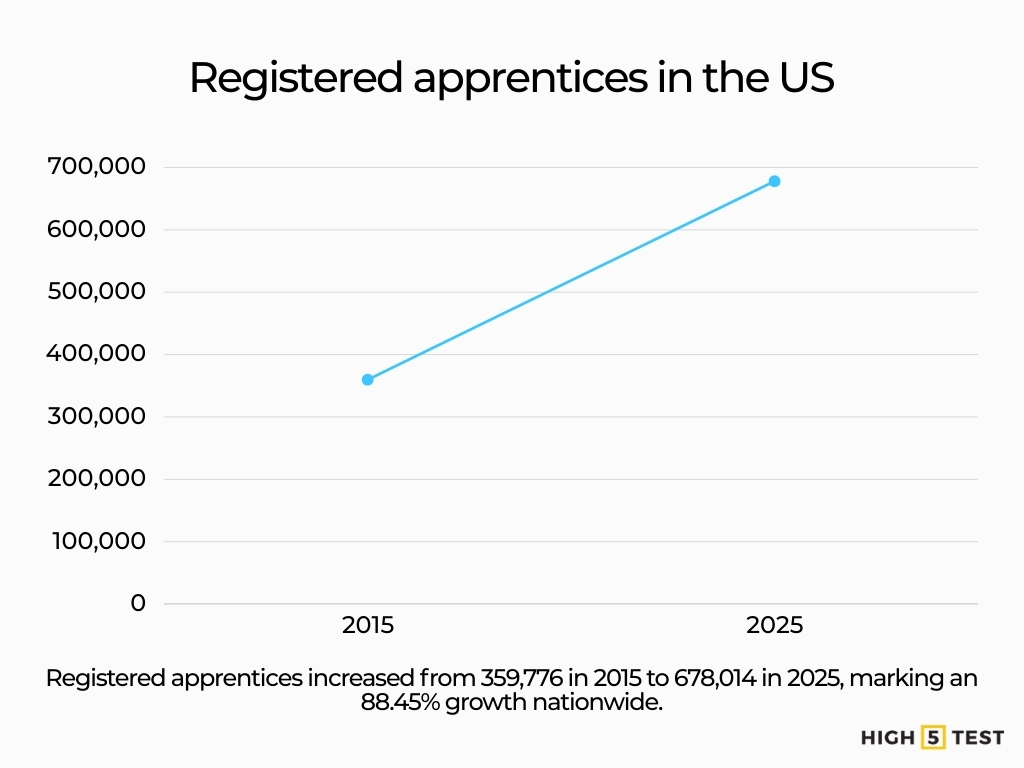
- 678,014 registered apprentices in the U.S. by 2025 – an 88.45% increase from 359,776 apprentices in 2015. Growth reflects expansion of programs nationwide.
- Active registered apprentices total about 680,000 in the U.S., indicating apprenticeship expansion continues in 2024–2025.
- Youth apprentices increased by about 100,000 from FY 2020 to FY 2024, showing stronger school-to-career pipelines.
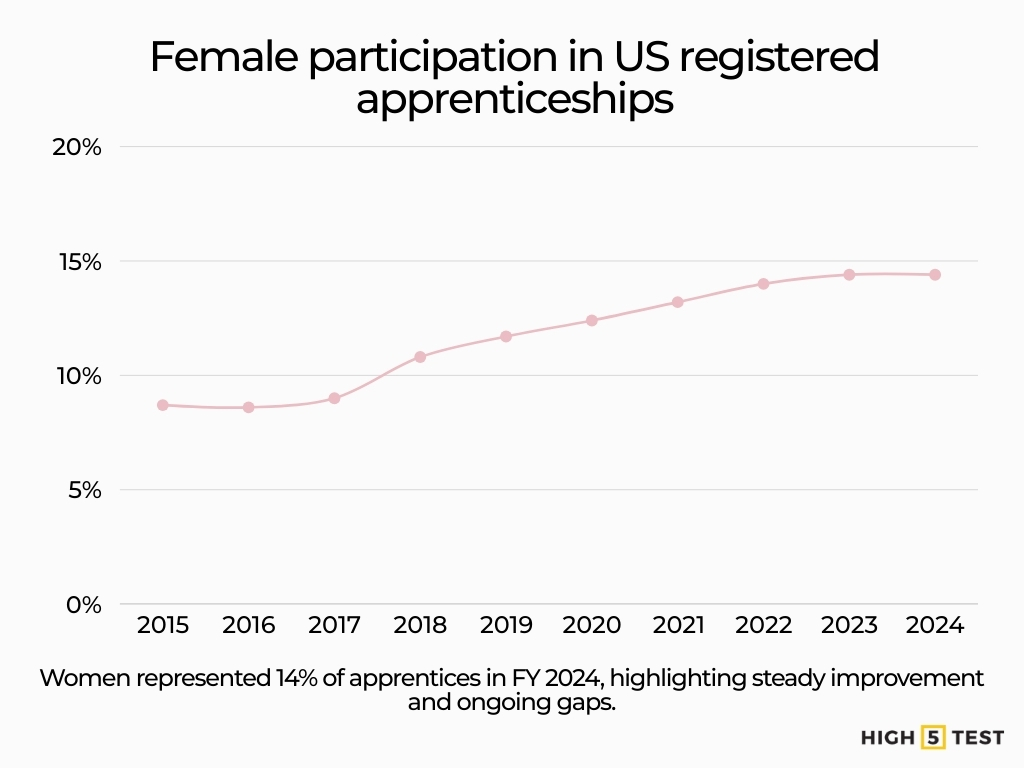
- Women account for about 14% of active apprentices in FY 2024, evidence of progress but continued underrepresentation.
- Median annual earnings of $80,700 one year after completion (Michigan data) demonstrates strong post-apprenticeship income potential.
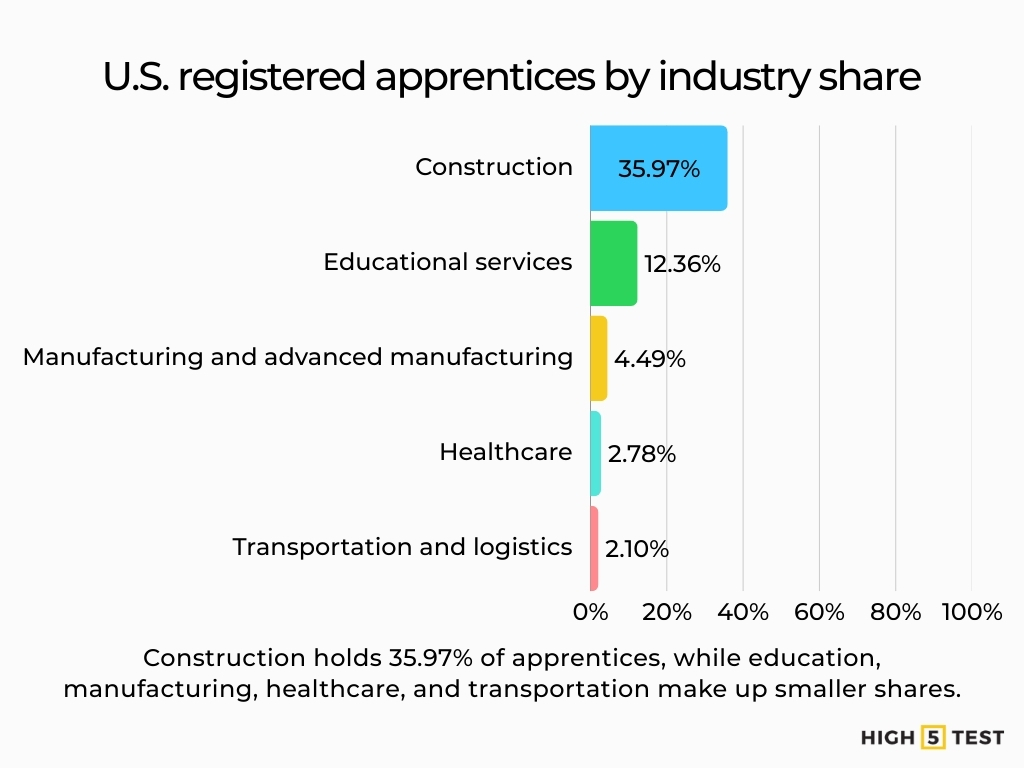
- Construction occupations make up 35.97% of U.S. registered apprentices – showing the sector’s dominant role.
- Educational services represent 12.36% of registered apprenticeships, indicating diversification beyond traditional trades.
- Manufacturing apprentices account for 4.49% of total registered apprentices – a meaningful share of the skilled workforce pipeline.
- Transportation and logistics occupations make up 1.10% of registered apprenticeships, highlighting niche but growing fields.
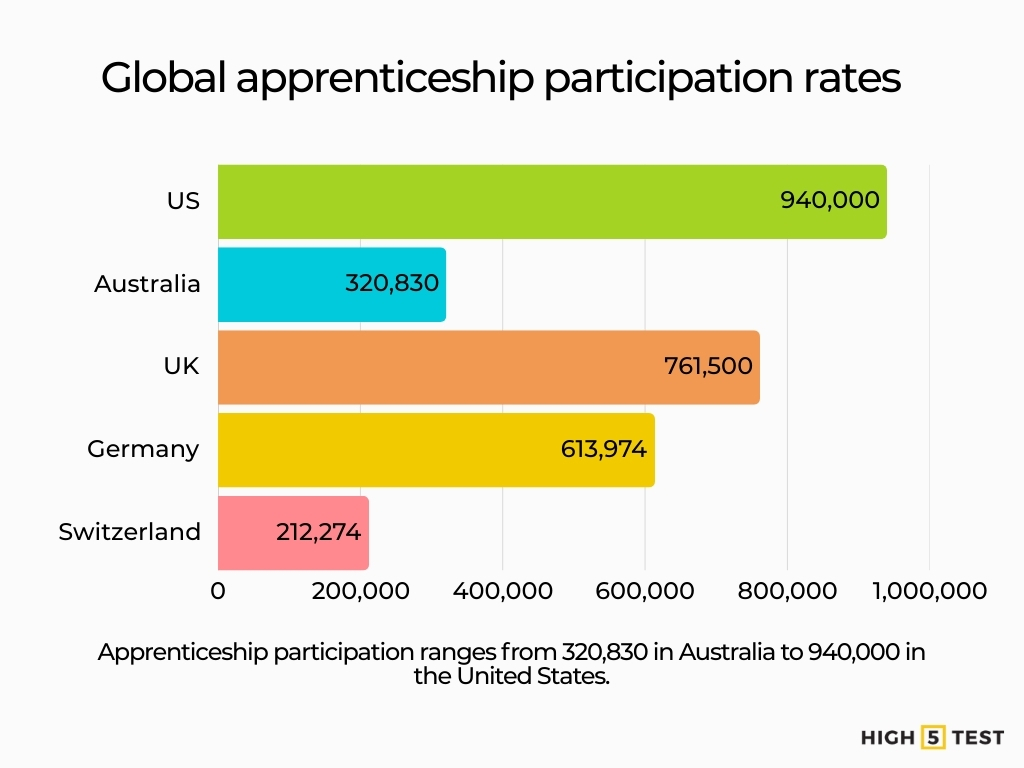
- About 940,000 U.S. workers were enrolled in apprenticeships in 2024 (all programs, not just registered), underscoring broader apprenticeship participation beyond federal registrations.
What is a registered apprenticeship?
In the U.S., a Registered Apprenticeship is a work-based training model officially recognized and overseen by the U.S. Department of Labor. These programs combine paid training with structured instruction and culminate in nationally recognized credentials.
20+ apprenticeship statistics in the U.S. (2024/2025)
Federal data shows steady expansion in registered apprenticeship participation over the past decade. The numbers reflect growth in total apprentices, stronger youth pipelines, and gradual gains in gender diversity.
Rapid growth over the decade
Federal totals rose from 359,776 registered apprentices in 2015 to 678,014 in 2025. That is an increase of about 88.45%.
Source: Learn & Work Ecosystem Library
Youth participation
Youth apprentices served from FY 2020 to FY 2024 increased by about 100,000. They now make up a larger share of total apprentices. Youth growth often reflects stronger school-to-career pipelines and employer interest in early talent.
Source: Department of Labor
Women in apprenticeships
Female participation rose over the past decade, though women were still about 14% of active apprentices in FY 2024. It shows measurable progress, yet women remain underrepresented in many apprenticeship fields.
Source: Department of Labor
Statistics on apprenticeship earnings and outcomes
National earnings trends
Michigan data reports a median annual salary of $80,700 one year after completion for 2024 apprentices. A median above $80,000 indicates strong post-completion earnings in that state sample.
Source: Michigan Center for Data and Analytics
Federal and state support and funding
The Registered Apprenticeship system operates under oversight from the US Department of Labor, working alongside state apprenticeship agencies. This structure sets national standards while allowing states to manage local program registration and compliance.
Federal funding supports grants, program expansion, and technical assistance for new sponsors. Many of these initiatives publish performance data and award details on the Apprenticeship.gov grants dashboard, which provides transparency into how funds are distributed and tracked.
Apprenticeship statistics by industry
The official Apprentices by State dashboard displays industry segmentation for registered apprentices in 2025 and shows how apprenticeships span construction, manufacturing, transportation, IT, healthcare, and more.
Construction
- 35.97% of all registered apprentices in the U.S. are in construction-related occupations.
Manufacturing and advanced manufacturing
- Around 4.49% of all U.S. apprentices are enrolled in manufacturing and machine-related occupations.
Educational services
- Educational services now represent about 12.36% of U.S. registered apprenticeships.
Healthcare
- Healthcare support and allied health occupations account for 2.78% of all registered apprenticeships in the U.S.
Transportation and logistics
- Transportation and material moving occupations make up about 1.10% of active apprenticeships nationwide.
Source: Apprenticeship.gov
Global apprenticeship comparisons
United States
About 940,000 U.S. workers were enrolled in apprenticeship programs in 2024.
Source: U.S. Government Accountability Office
Australia
In Australia, about 320,830 were registered apprentices as of 2025.
Source: NCVER
United Kingdom
England recorded 761,500 apprenticeship participants in 2024–25, equivalent to roughly 2.2% of the English workforce.
Source: UK Parliament Research Briefing
Germany
613,974 participate in an apprenticeship program. A majority of youth in vocational education move into apprenticeship tracks.
Source: Statistisches Bundesamt
Switzerland
Up to about 212,274 Swiss youth complete apprenticeship-style vocational tracks. More than half of young people enter the workforce through apprenticeship pathways.
Source: Federal Statistical Office
Conclusion
US apprenticeships continue to grow in total numbers, youth participation, and industry spread. Active participation stands near 680,000, yet the overall workforce share remains at about 0.4%. International comparisons show that several countries operate at much higher participation rates. The data points to clear expansion in the US, alongside significant room for further growth.
Industry distribution shows a clear concentration in construction at 35.97%, while other sectors such as education, manufacturing, healthcare, and transportation account for smaller shares. This mix confirms that apprenticeship remains rooted in the skilled trades, even as it spreads into new occupational areas.
Despite steady growth, apprenticeships account for about 0.4% of the US workforce. That equals roughly 4 apprentices per 1,000 workers. Countries such as the United Kingdom, Germany, and Switzerland report much higher participation rates, which highlights the scale gap that still exists. Continued increases in participation, stronger completion numbers, and broader industry adoption will determine how much apprenticeship expands in the coming years.
FAQ
How many registered apprentices are there in the US?
Federal dashboards report about 680,000 active registered apprentices around FY 2024 to 2025. Totals are published through September 2025 on the Apprentices by State dashboard. This number reflects active participants at a point in time, not cumulative enrollments over multiple years.
Are apprenticeships growing in the U.S.?
Yes. Participation increased from 359,776 in 2015 to 678,014 in 2025, an increase of about 88%.
What share of apprentices are women?
In FY 2024, women made up about 14% of active apprentices, according to DOL demographic analysis. Roughly 1 in 7 apprentices is female, which indicates continued underrepresentation compared to overall workforce participation.
What industries use apprenticeships?
Government dashboards show apprenticeships across construction, manufacturing, transportation, healthcare, and emerging tech sectors.