Employee engagement in the United States is at a defining moment. As organizations navigate hybrid work, economic uncertainty, rapid AI adoption, and shifting employee expectations, engagement has become a critical indicator of workforce stability, performance, and retention. In 2024, engagement levels stabilized after years of disruption, but significant gaps remain across roles, industries, and leadership levels.
This 2024–2025 U.S. Employee Engagement Report analyzes the latest engagement trends, benchmarks, and drivers shaping the modern workplace. Using U.S.-focused data with global comparisons, the report highlights what is influencing engagement today, where organizations are falling behind, and how leaders can build more resilient, high-performing teams in 2025 and beyond.
Key findings from the Employee Engagement Report
- Employee engagement in the U.S. remains fragile but stable, with modest improvements over 2023, yet still below pre-2020 highs.
- Managers and frontline leaders show the largest engagement declines, signaling burnout and capability gaps.
- Career growth, recognition, and leadership trust are the strongest engagement drivers in 2024–2025.
- Hybrid work and flexibility are now baseline expectations, not perks.
- Well-being, psychological safety, and inclusion show a direct connection to retention and performance.
- Organizations that act quickly on survey feedback outperform those that rely on annual, static engagement cycles.
Defining employee engagement in 2025
Employee engagement reflects the emotional connection employees feel toward their work, their organization, and shared goals. Engaged employees show motivation, alignment with values, and a willingness to give extra effort.
In 2025, engagement extends beyond satisfaction. Core elements now include:
- A clear sense of purpose
- Trust in leadership decisions
- Access to growth and development
- Feeling valued, heard, and included
Why employee engagement matters for U.S. organizations
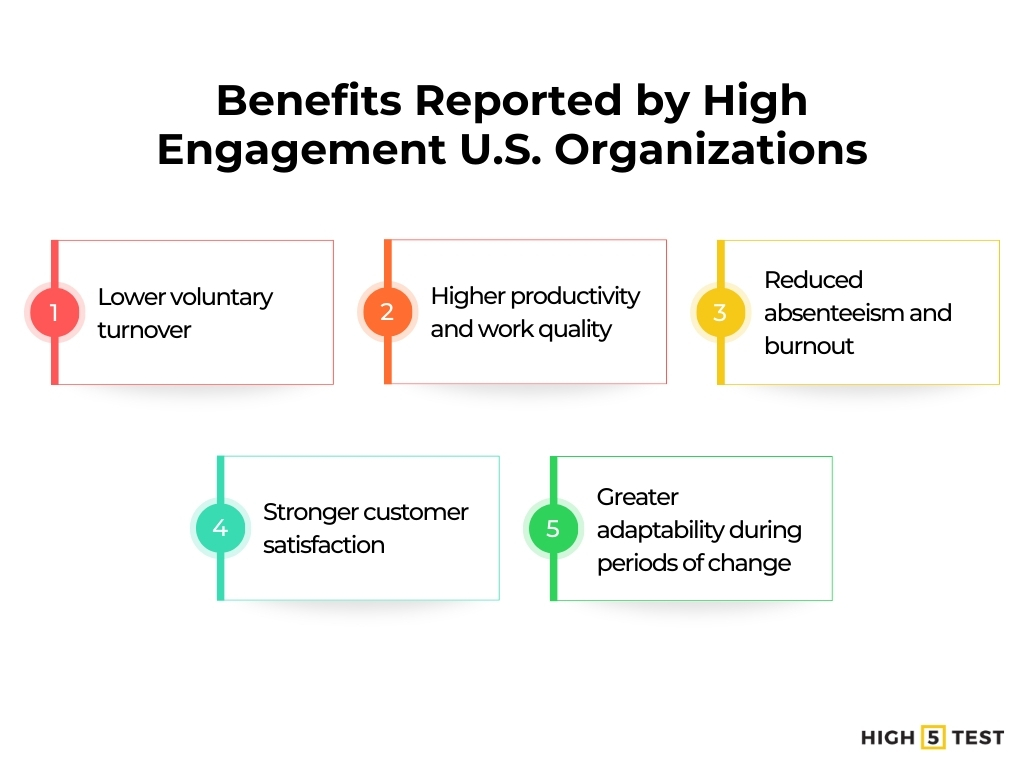
Longstanding research shows a strong link between engagement and business outcomes. U.S. organizations with higher engagement report:
- Lower voluntary turnover
- Higher productivity and work quality
- Reduced absenteeism and burnout
- Stronger customer satisfaction
- Greater adaptability during periods of change
Disengagement carries high costs. Replacing an employee can cost between 50% and 200% of an employee’s annual salary, not including lost knowledge and momentum.
Key U.S. employee engagement benchmarks
Engagement levels over time
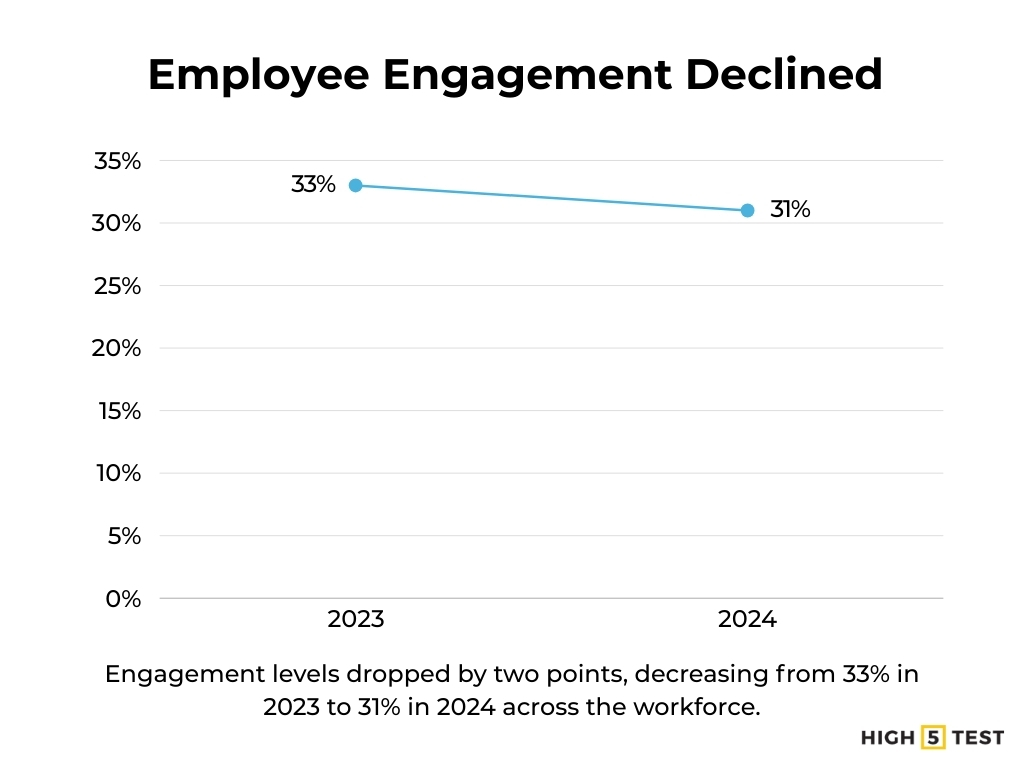
Engagement in the U.S. peaked before 2020 and dropped sharply during the pandemic. Since then, recovery has been slow.
Recent data highlights several patterns:
- Engaged employees declined by two percentage points since 2023
- Progress varies widely by industry and job level.
- Managers and mid-level leaders face the highest risk of disengagement.
U.S. vs global engagement
U.S. engagement remains slightly above global norms. The difference continues to shrink as other regions benefit from clearer work-life boundaries and stronger social support systems.
Major engagement trends in 2024 and 2025
1. Engagement has reached a ten-year low
Employee engagement dropped to its lowest level in a decade in 2024. Only 31% of U.S. employees were engaged, matching 2014 levels. Actively disengaged employees reached 17 percent, also the same as in 2014.
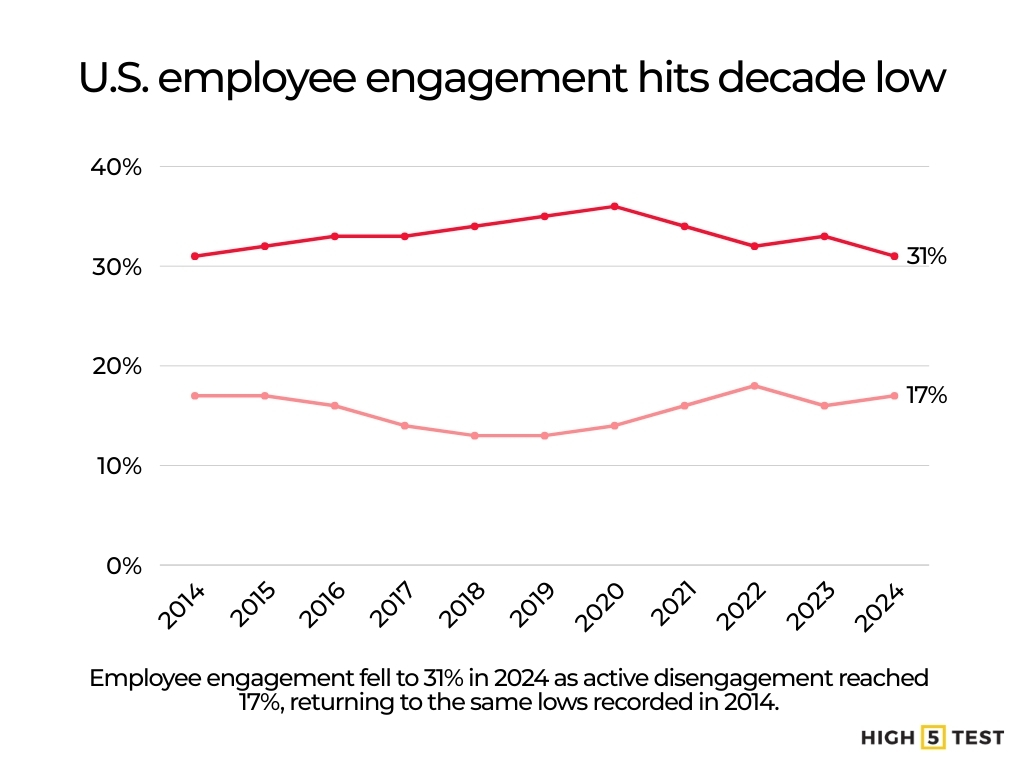
These results show that engagement did not stabilize. Instead, it moved backward after several years of uneven recovery. Many organizations are no longer holding ground and now face a clear erosion of commitment across the workforce.
2. Manager engagement continues to decline
Managers are facing the steepest drop, with engagement levels decreasing from 30% to 27%. Declining engagement among managers is often due to:
- Expanding workloads
- People’s leadership duties without sufficient training
- Pressure tied to return-to-office mandates
- Emotional demands without enough support
3. Feedback without action damages trust
Employees report higher survey fatigue and less confidence that feedback leads to change. Engagement efforts without visible follow-up weaken trust rather than strengthen it.
Key forces shaping employee engagement
Hybrid work is now non-negotiable
Flexibility is now expected. Organizations that limit hybrid options without a clear explanation see drops in engagement and retention, especially among top performers.
AI and technology bring opportunity and uncertainty
AI is reshaping work at every level. While employees recognize efficiency gains, many express:
- Fear of job displacement
- Unclear expectations around AI use
- Insufficient training and communication
Engagement improves when AI adoption includes transparency, skill development, and clear expectations.
Well-being and psychological safety
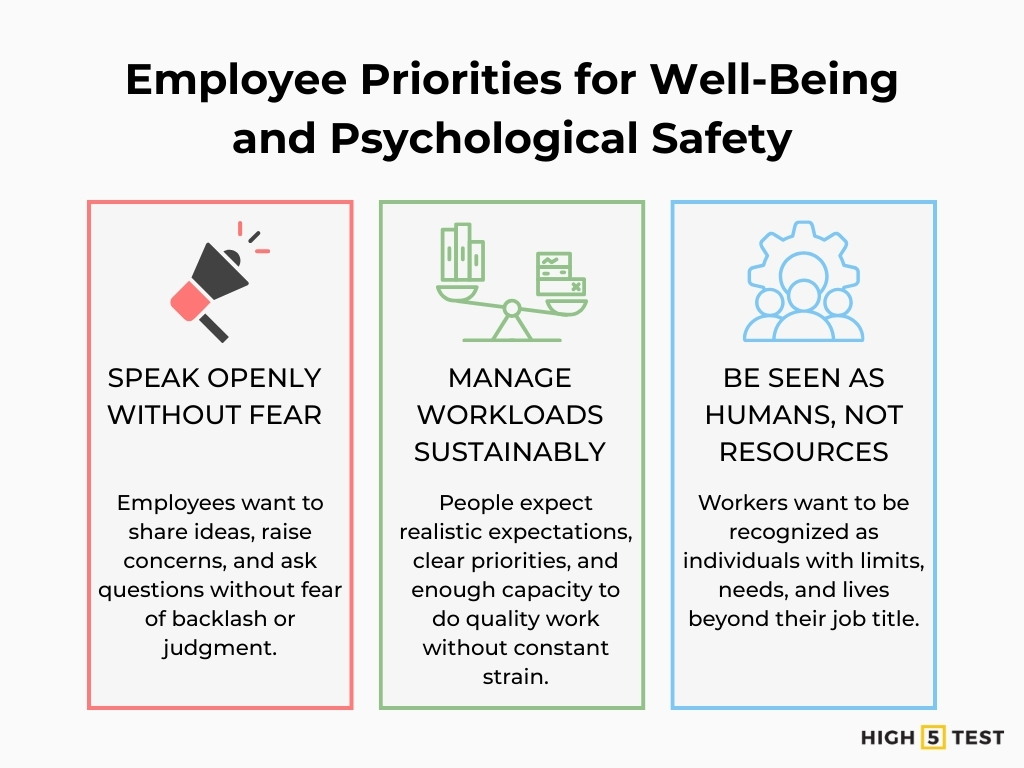
Mental health and burnout prevention rank among the top engagement drivers. Employees want workplaces where they can:
- Speak openly without fear
- Manage workloads sustainably
- Be seen as humans, not resources
Leadership trust and communication
Open and honest communication from leaders strongly predicts engagement during change. Silence and vague messaging correlate with disengagement.
The strongest drivers of engagement
Career growth and development
Employees stay engaged when they see a future with their organization. Learning opportunities, internal mobility, and clear career paths often outweigh pay increases alone.
Recognition and feeling valued
Recognition matters most when it feels personal and timely. Specific acknowledgment of effort and results supports motivation and retention.
Leadership effectiveness
Confidence in senior leaders and direct managers remains a top predictor of engagement. Employees disengage quickly when leaders appear distant, inconsistent, or unavailable.
Engagement segmentation: Who is most at risk?
U.S. engagement data consistently shows four broad employee segments:
- Highly engaged contributors – Strong performers with high commitment
- Quiet contributors – Reliable but emotionally disconnected
- At-risk employees – Declining engagement and increased turnover risk
- Actively disengaged employees – Low morale and potential culture damage
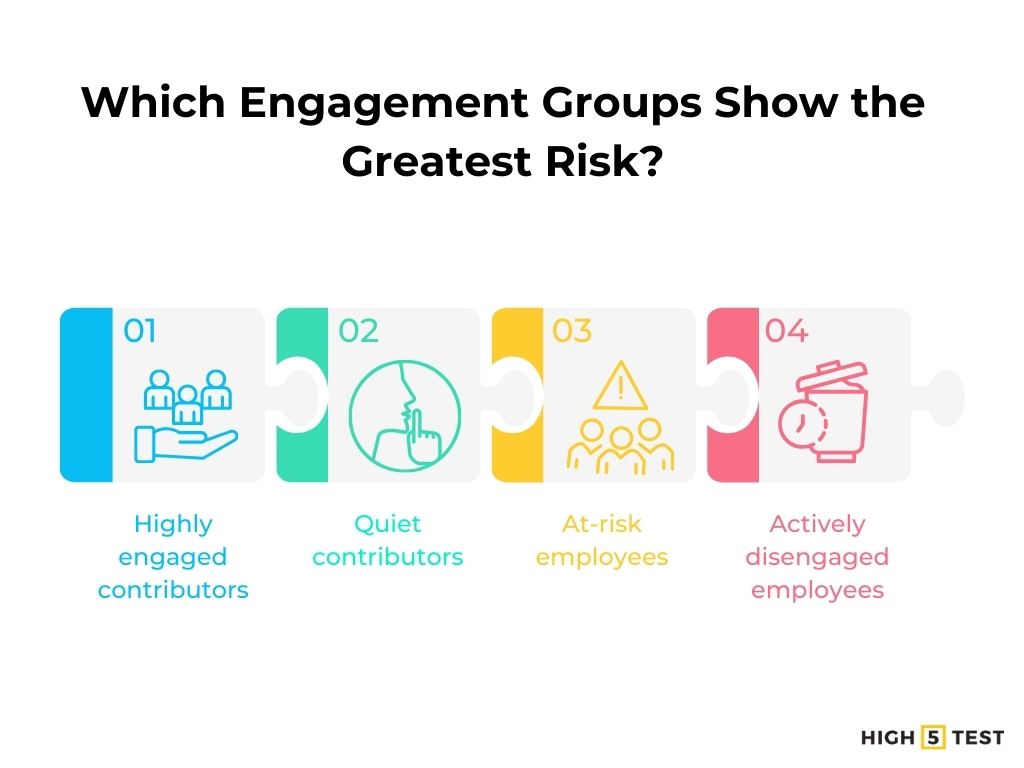
Disengagement often clusters around unclear expectations, weak management support, and limited growth options.
The business impact of employee engagement
Organizations with high engagement consistently outperform peers on:
- Revenue growth
- Customer loyalty
- Innovation
- Talent retention
Disengagement creates hidden costs through presenteeism, errors, and lost momentum. These losses often exceed the visible costs of turnover.
What U.S. organizations should do
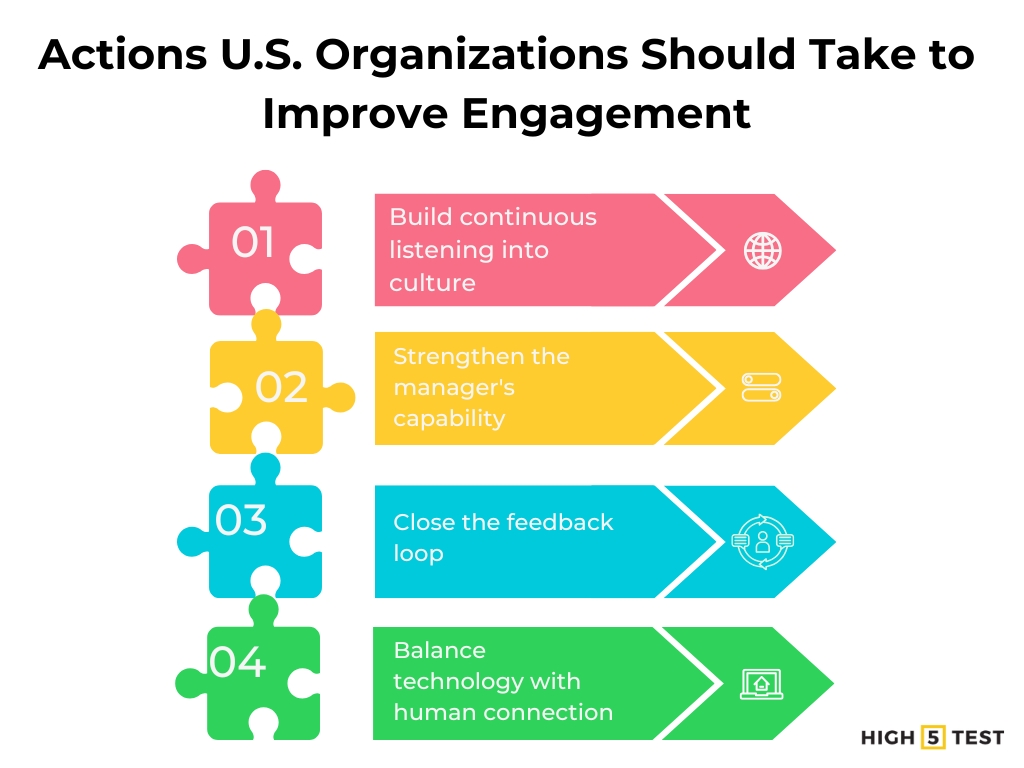
1. Build continuous listening into culture
Annual surveys no longer meet employee expectations. Pulse surveys, lifecycle feedback, and continuous listening tools allow faster and more credible responses.
2. Strengthen the manager’s capability
Manager capability remains the strongest lever for engagement improvement. Training in coaching, feedback, and emotional intelligence delivers measurable returns.
3. Close the feedback loop
Even small changes build trust when leaders explain what is changing and why. Visibility into progress matters as much as the action itself.
4. Balance technology with human connection
AI and automation should reduce friction and support clarity. Engagement improves when technology reinforces autonomy, growth, and collaboration.
Additional action options to consider
Organizations also see gains from:
- Clear communication around priorities
- Simplified processes that reduce workload strain
- Manager of peer support communities
- Career conversations tied to real opportunities
- Regular recognition rituals at the team level
Conclusion: Employee engagement in 2025
The 2024-2025 data shows engagement has stabilized, yet progress depends on action rather than measurement alone. Consistent drivers remain clear. Trust in leadership, meaningful growth, recognition, flexibility, and psychological safety continue to shape engagement outcomes.
Organizations that ignore employee feedback face stagnation, disengagement, and higher turnover. Looking ahead, manager capability and human-centered leadership will define engagement success. As AI and new work models evolve, companies that pair technology with transparency, continuous listening, and visible follow-through will build stronger and more resilient teams. Employee engagement in 2025 stands as a clear source of strategic advantage.