
From my personal experience working with personality tests in hiring, employee engagement, leadership development, and team workshops, one thing is clear: there is no single “best” personality test for every workplace use case. What matters is intent.
Some personality tests are built to predict job performance. Others help teams communicate better. Some are designed for deep self-awareness, while a few are genuinely practical for everyday work conversations.
Below, I break down the best personality tests for the workplace, explaining what each one measures, how it’s used at work, and when it actually makes sense to use it, without hype, and without oversimplification.
Verdict: Top personality tests for work
- HIGH5 Strengths Test: A free online strengths assessment that identifies your top five personal strengths. It measures what energizes you and what you’re naturally good at, then ranks your strongest talents with tips for applying them. Great for personal development and understanding team roles.
- DiSC Personality Test: A popular behavioral-style inventory (Dominance, Influence, Steadiness, Conscientiousness) used by millions in business. It shows how you prefer to communicate and work with others, helping improve teamwork and communication.
- Hogan Personality Inventory (HPI): A validated trait-based test built on the Big Five model, focusing on “bright side” personality – how we relate at our best. Used by companies for hiring and leadership development, it predicts job performance and leadership potential.
- Caliper Profile: A comprehensive workplace assessment (now Talogy Caliper) that measures both personality traits and cognitive abilities. It evaluates problem-solving, motivation, and interpersonal skills, and is widely used by organizations for hiring and coaching.
- Big Five Personality Test: Measures the five core traits (Openness, Conscientiousness, Extraversion, Agreeableness, Neuroticism – OCEAN). This scientifically grounded model is the “gold standard” of personality research, giving a broad profile of your work behavior. Free versions are available online.
- Enneagram Test: Assesses personality across nine types (e.g. Achiever, Helper, etc.) based on core motivations and fears. Popular in personal growth and teams, it provides insight into one’s motivations and how to communicate effectively at work.
- Myers-Briggs Type Indicator (MBTI): Sorts people into 1 of 16 types (e.g. INTJ, ESFP) based on four dichotomies (E/I, S/N, T/F, J/P). Widely used for career counseling and team-building, it highlights individual work preferences and communication styles. (Note: MBTI is a self-report tool whose reliability is debated, but it remains very popular in organizations.)
Each of these free tests serves a different purpose: strengths/focus (HIGH5), behavior style (DiSC), trait-based profile (HPI, Big Five, MBTI), or motivation/values (Enneagram). They are used for career insight, team development, leadership training, and self-awareness in the workplace.
1. HIGH5 Strengths Test
HIGH5 Strengths Test is the personality test I’ve seen generate the most immediate impact in workplace settings, especially when the goal is engagement, clarity, and performance rather than labeling.
HIGH5 is a strengths-based personality test, sometimes referred to as a workplace strengths assessment or talent strengths test. Unlike traditional personality models that focus on traits or behavior styles, HIGH5 is built around a simple but powerful question: What do you naturally do best at work?
When I first reviewed a HIGH5 report, what stood out immediately was how usable it felt. Instead of abstract descriptions, the report shows your Top 5 work strengths, explains how they show up on the job, and, most importantly, how they create value for a team or organization.
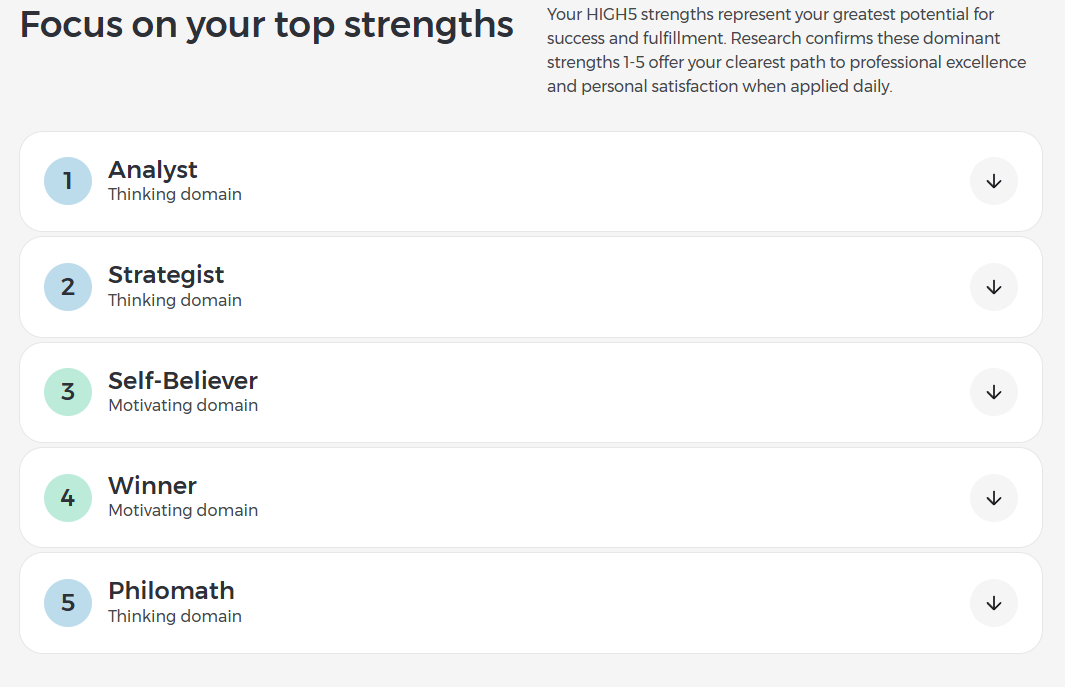
My results are: Analyst, Self-Believer, Strategist, Winner, and Philomath.
The report doesn’t just describe personality. It connects strengths to real work outcomes like collaboration, communication, problem-solving, leadership, and motivation. For employees, this creates confidence and direction. For managers, it creates a shared language that’s actually actionable.
HIGH5 is primarily used for employee engagement, team building, career development, onboarding, and leadership growth. Because it focuses on strengths rather than deficiencies, it’s especially effective in modern workplaces where psychological safety and motivation matter.
The assessment is taken online and typically takes about 15 minutes to complete. A free version is available, which already delivers meaningful insight, while paid reports unlock deeper analysis, team mapping, and development tools.
From a reliability standpoint, HIGH5 is psychometrically validated and designed specifically for workplace application – not clinical diagnosis. One thing to be aware of is that it intentionally avoids focusing on weaknesses, which can feel unfamiliar to organizations used to traditional evaluation models.
That said, if the goal is performance, engagement, and long-term development, HIGH5 is one of the most practical personality tests available today.
2. DiSC Personality Test
The DiSC personality test is one of the most commonly used tools in corporate training and I’ve seen it used extensively in communication and leadership workshops.
DiSC doesn’t measure personality in the deep psychological sense. Instead, it focuses on observable behavior, particularly how people act in workplace situations. The model is built around four primary styles: Dominance, Influence, Steadiness, and Conscientiousness.
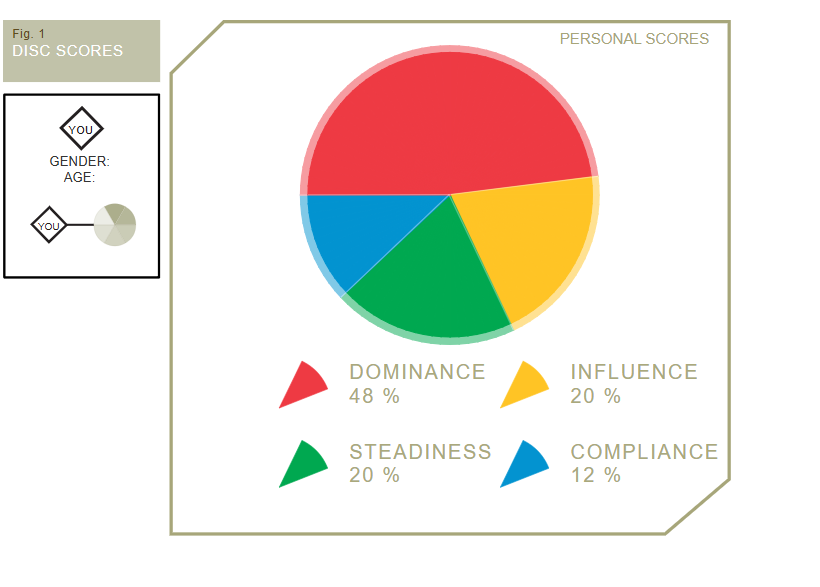
My DISC style is Dominance. Within the Dominance quadrant, I fall towards Influence. So, my DISC type is Di.
In practice, DiSC is most often used to improve communication, teamwork, and conflict management. It helps people understand why colleagues may approach tasks, decisions, or conversations differently—and how to adapt their style when working together.
The assessment is quick to complete and relatively easy to understand, which makes it popular in group workshops. However, because it simplifies behavior into four categories, it doesn’t capture the full complexity of personality or motivation.
DiSC works best when the goal is short-term behavioral awareness, not deep personal or career development.
3. Hogan Personality Inventory (HPI)
The Hogan Personality Inventory is one of the most scientifically rigorous personality tests used in professional settings.
HPI is grounded in the Five-Factor Model and is designed to measure normal personality characteristics as they relate to job performance. I most often encounter it in high-stakes situations such as executive hiring, leadership selection, and succession planning.
What makes Hogan powerful is its predictive focus. It doesn’t aim to make people feel seen or inspired, it aims to predict how someone is likely to behave in a role over time, especially under pressure and responsibility.
The reports are detailed and data-heavy, often interpreted by psychologists or certified HR professionals. Because of this, Hogan assessments are not typically self-administered or casually discussed with employees.
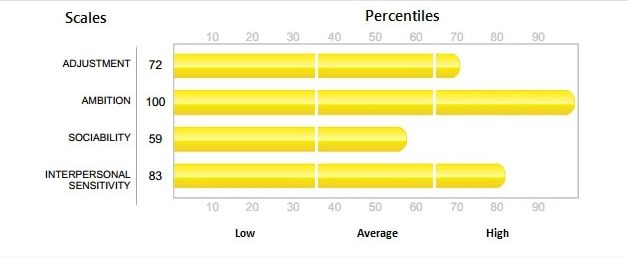
My result is:
HPI is extremely reliable, but it’s also expensive and complex, making it unsuitable for small teams or engagement initiatives. It’s a tool for organizations that need risk reduction and precision, not everyday development conversations.
4. Caliper Profile
The Caliper Profile blends personality traits with motivational drivers and performance indicators.
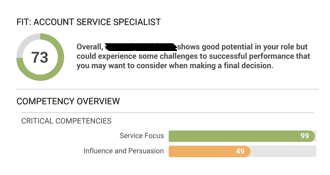
From what I’ve seen, Caliper is most often used in hiring, promotion, and role-fit decisions, particularly for sales, leadership, and customer-facing roles. It’s less about self-discovery and more about predicting how someone will perform in a specific job context.
The assessment goes beyond surface traits and looks at factors like assertiveness, resilience, urgency, and interpersonal orientation. This makes it appealing to organizations focused on measurable outcomes.
Like Hogan, Caliper is professionally administered and paid. Employees don’t always feel an emotional connection to the results, but hiring managers value the structured insight.

Its biggest limitation is that it’s not designed for engagement or team bonding. It’s a decision-support tool, not a development framework.
5. The Big Five Personality Test
The Big Five Personality Traits is the personality framework I trust the most from a scientific credibility standpoint and also the one I’m most cautious about recommending for everyday workplace use.
The Big Five measures personality across five broad dimensions: Openness, Conscientiousness, Extraversion, Agreeableness, and Neuroticism. These traits have been replicated across cultures, languages, and decades of research, which is why the model is often considered the backbone of modern personality psychology.
From an organizational perspective, the Big Five is frequently used in research, large-scale workforce analytics, and longitudinal studies. When companies want statistically reliable insight into personality trends across departments, roles, or regions, this model delivers.
Where I see a gap is in practical application. Big Five results are accurate, but they’re also abstract. Telling an employee they score “high on Conscientiousness and low on Neuroticism” doesn’t automatically translate into better collaboration, clearer career direction, or stronger engagement, unless there’s skilled interpretation involved.
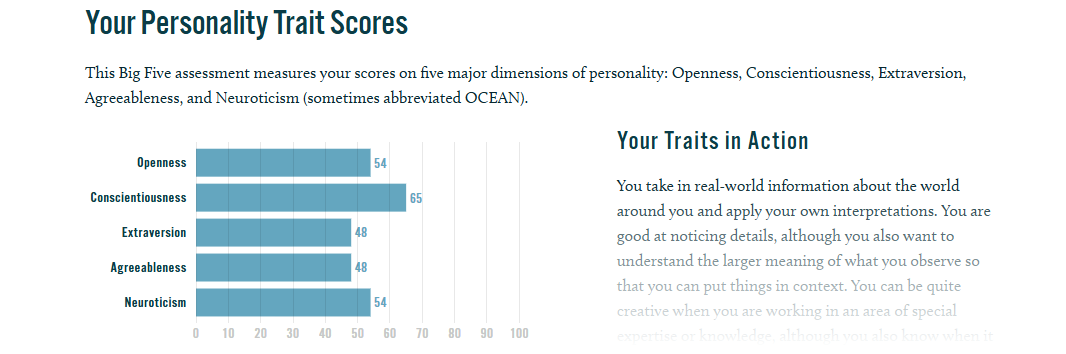
After taking the Big Five test, my best result or score was in conscientiousness.
I’ve seen Big Five assessments work well when paired with experienced coaches, organizational psychologists, or structured development programs. In those contexts, the depth of the model becomes a strength. Without that support, employees often struggle to connect trait scores to real behavior at work.
Another important consideration is emotional impact. Because the Big Five includes dimensions related to emotional stability, results can feel judgmental or personal if they’re not introduced carefully. This makes it less suitable for onboarding, team bonding, or psychologically sensitive environments.
In short, the Big Five is an excellent measurement model, but a limited engagement tool. It’s ideal when accuracy and research validity matter more than immediacy and accessibility. For most teams, it answers the question “What does personality look like in aggregate?” rather than “How do I work better tomorrow?”
That distinction makes all the difference in the workplace.
6. Enneagram Test (Workplace Use)
The Enneagram is one of the most misunderstood tools I see being brought into workplace conversations.
At its core, the Enneagram is not a behavior model and not a performance tool. It’s a framework for understanding why people do what they do, rooted in core motivations, fears, and emotional drivers. That distinction matters a lot at work.
When I’ve seen the Enneagram used well in organizations, it’s almost always in coaching, leadership reflection, or facilitated team development, not in hiring or evaluation. It helps people recognize blind spots, stress reactions, and unconscious patterns that influence how they lead, communicate, and respond to pressure.
What makes the Enneagram powerful is depth. Unlike most workplace personality tests, it doesn’t stop at surface traits. It digs into internal narratives, what people seek for security, validation, or control—and how those motivations shape workplace behavior over time.
That depth, however, is also its biggest limitation in professional settings. Without skilled facilitation, Enneagram results can become over-identified labels rather than growth tools. I’ve seen teams reduce complex individuals to “a Type 3” or “a Type 6,” which defeats the purpose entirely.
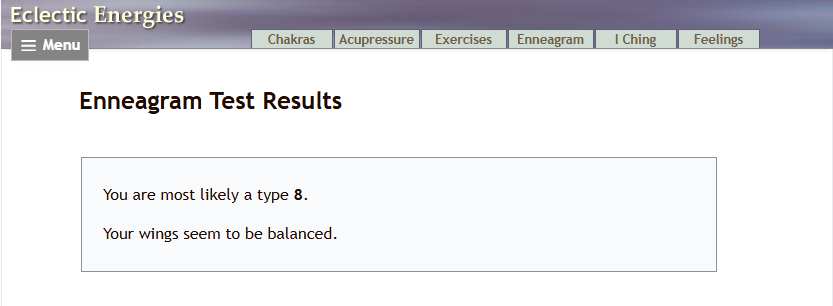
My result is type 8 with balanced wings.
From a practical standpoint, Enneagram tests vary widely in quality, reliability, and interpretation. Many are self-reported and not psychometrically validated in the same way as occupational assessments. For that reason, the Enneagram should never be used for hiring, promotion, or performance decisions.
Where it does belong is in self-awareness, emotional intelligence development, leadership coaching, and trust-building conversations, especially in mature teams willing to do deeper work.
7. Myers-Briggs Type Indicator (MBTI)
The Myers-Briggs Type Indicator is, without question, the most recognizable personality test in the workplace—and also one of the most frequently misused.
MBTI is based on Carl Jung’s theory of psychological types and measures personality preferences, not skills, competence, intelligence, or performance. That distinction is critical, yet often ignored.
In my experience, MBTI works best as a shared language tool. It helps people understand differences in how colleagues prefer to process information, make decisions, and structure their work. Used this way, it can reduce misunderstanding and normalize cognitive diversity.
Where MBTI tends to fall apart is when organizations try to stretch it beyond its purpose. It has no predictive validity for job performance, and even its creators explicitly warn against using it for hiring or evaluation. Still, I regularly see teams quietly making assumptions based on someone’s type.
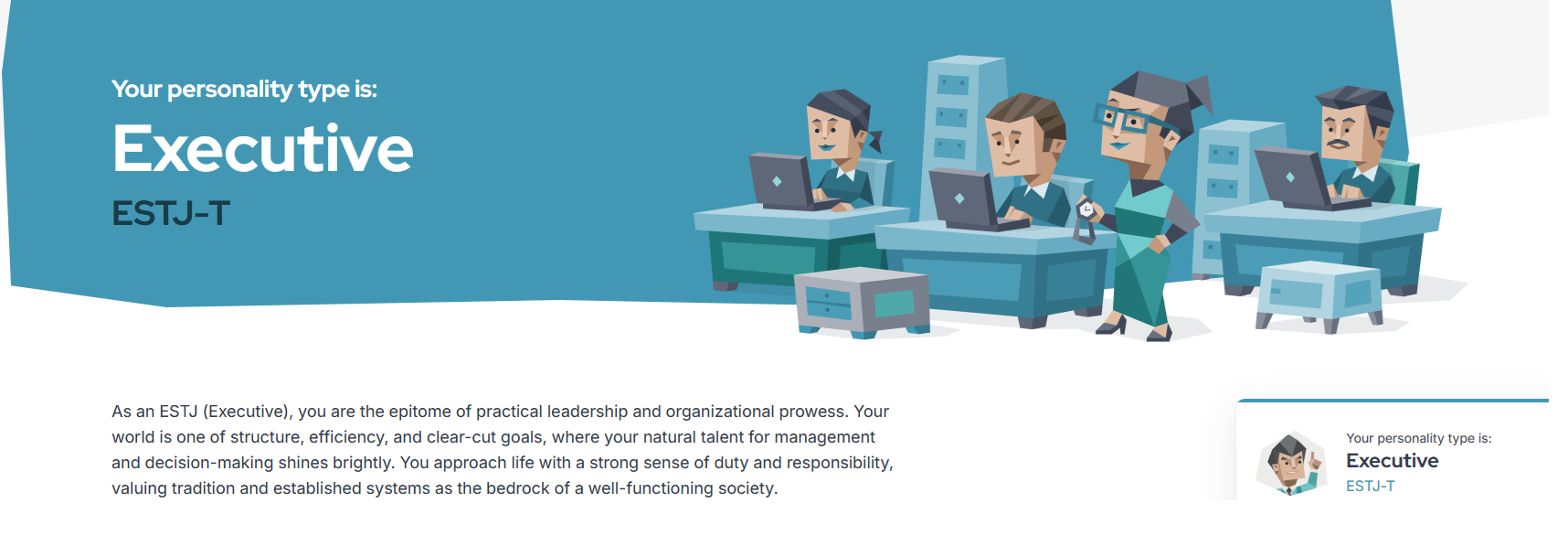
My results are ESTJ-T, also known as Executive.
Another limitation is that MBTI types are binary and static, while real people are contextual and adaptive. Two people with the same type can behave very differently depending on role, culture, stress level, and experience.
That said, when used responsibly, in workshops, onboarding sessions, or team offsites, MBTI can be an effective reflection and conversation starter. It helps teams talk about differences without immediately tying those differences to judgment.
Think of MBTI as a mirror, not a measurement tool.
Comparison Table: Best Personality Tests for the Workplace
| Test | What It Measures | Best Used For | Workplace Strength | Key Limitation |
|---|---|---|---|---|
| HIGH5 Strengths Test | Natural work strengths | Engagement, team building, career development | Highly actionable, strengths-focused | Less focus on weaknesses |
| DiSC | Observable behavior styles | Communication, conflict reduction | Easy to understand, fast adoption | Oversimplifies personality |
| Hogan Personality Inventory (HPI) | Workplace personality traits | Executive hiring, leadership selection | Strong predictive validity | Expensive, complex |
| Caliper Profile | Traits + motivation + performance indicators | Hiring, promotion decisions | Role-fit insight | Not engaging for employees |
| Big Five | Core personality traits | Research, analytics | Scientifically robust | Abstract, hard to apply |
| Enneagram | Core motivations & fears | Coaching, leadership growth | Deep self-awareness | Not validated for hiring |
| MBTI | Personality preferences | Workshops, reflection | Shared language for teams | No performance prediction |
Which personality test should you choose for the workplace?
This is the question I get asked most often and the one most articles avoid answering clearly.
After working with all of these tools in real workplace contexts, I’ve learned that choosing the right personality test has far less to do with popularity and far more to do with intent. When organizations choose the wrong test, it’s usually because they’re trying to force one tool to do everything.
So instead of asking “Which is the best personality test?”, the better question is:
“What decision are you actually trying to support?”
Below is how I personally think about choosing the right personality test for the workplace.
If your goal is employee engagement, motivation, or retention
Choose HIGH5 Strengths Test.
If you’re trying to increase engagement, reduce burnout, or help employees feel valued for what they naturally do well, strengths-based assessments consistently outperform trait-based or type-based models. HIGH5 works because it shifts the conversation from “what’s wrong” to “where you create value.”
I’ve seen teams become more open, collaborative, and confident simply because people finally had language to describe their strengths and permission to use them at work.
If your goal is better communication and fewer interpersonal conflicts
Choose DiSC.
DiSC is ideal when teams are struggling with misunderstandings, friction, or mismatched communication styles. It doesn’t ask people to change who they are; it helps them recognize how they come across and adapt in the moment.
This makes DiSC particularly effective for sales teams, cross-functional collaboration, and leadership communication training.
If your goal is leadership selection or executive hiring
Choose Hogan Personality Inventory.
When the cost of a poor leadership hire is high, intuition isn’t enough. Hogan assessments are designed to reduce risk by predicting how someone is likely to behave over time, especially under pressure.
This is not an engagement or development tool, it’s a decision-making tool for high-stakes roles.
If your goal is hiring for role fit and performance potential
Choose Caliper Profile.
Caliper is most useful when you’re asking, “Will this person succeed in this specific role?” rather than “Who is this person?”
It’s especially effective for sales, leadership, and customer-facing positions where motivation and behavioral tendencies strongly influence results.
If your goal is research-backed personality insight
Choose the Big Five Personality Traits.
If scientific rigor is your top priority—such as in academic research, large-scale workforce analytics, or long-term organizational studies—the Big Five is unmatched.
Just be aware that without expert interpretation, the results can feel theoretical rather than practical.
If your goal is deep self-awareness and leadership coaching
Choose the Enneagram.
When used responsibly, the Enneagram can help leaders understand emotional patterns, stress responses, and unconscious drivers that influence how they show up at work.
This is a growth and reflection tool, not a performance metric.
If your goal is reflection, dialogue, and team understanding
Choose Myers-Briggs Type Indicator.
MBTI works best as a shared vocabulary for understanding different thinking and decision-making preferences. It’s helpful for onboarding, workshops, and team offsites—as long as it’s not used for evaluation or hiring.
Think of it as a starting point for conversation, not a final answer.
Final takeaway
From my experience, the most effective workplaces don’t rely on a single personality test. They use the right tool at the right moment, with clear boundaries around what that tool can and cannot do.
If you want one assessment that works across engagement, development, and everyday collaboration, strengths-based tools like HIGH5 tend to offer the best return. For high-stakes decisions, more clinical and predictive tools have their place. Clarity of intent always comes first.