
Artificial intelligence is changing how many US companies recruit, screen, and hire. Teams use AI for tasks like drafting job descriptions, reviewing resumes, and matching candidates to skills. Adoption is rising, but trust and quality concerns are rising too.
You will find adoption rates, recruiter and job seeker sentiment, common use cases, and hiring signals from job postings. Each data point includes a short explanation you can apply to real hiring workflows.
10 most interesting AI recruitment statistics
- 51% of U.S. organizations use AI to support HR activities, showing that AI has moved beyond niche pilots into mainstream HR adoption.
- 64% of organizations that use AI in HR apply it specifically to recruiting, interviewing, or hiring, indicating talent acquisition is the leading use case for HR AI tools.
- 47% of HR professionals say AI has become more of a priority in the past 12 months, revealing rapid year-over-year growth in leadership focus on AI.
- 38% of HR leaders are piloting, planning, or implementing generative AI, demonstrating a significant acceleration in enterprise investment in GenAI for talent workflows.
- 27% of talent professionals are actively using or experimenting with GenAI, highlighting that hands-on adoption lags strategic planning, likely due to skills, policy, or trust gaps.
- 65% of hiring managers have caught candidates using AI deceptively (e.g., AI-generated scripts, hidden prompts, deepfakes), pointing to an emerging “AI arms race” in job applications.
- Only 8% of U.S. job seekers believe AI makes hiring more fair, revealing a major candidate trust gap that could affect application rates and employer branding.
- 91% of recruiters report encountering candidate deception, showing that AI-driven misinformation or low-quality applications are now the norm in many hiring pipelines.
- 21% of U.S. workers say at least some of their work is done with AI, up from 16% last year, suggesting that AI fluency is becoming a cross-industry skill employers will increasingly expect.
- Approximately 9% of HR job postings mention AI, indicating that AI tool literacy is becoming a new baseline expectation for HR professionals in 2025.
25+ AI recruiting statistics in the U.S. (2024/2025)
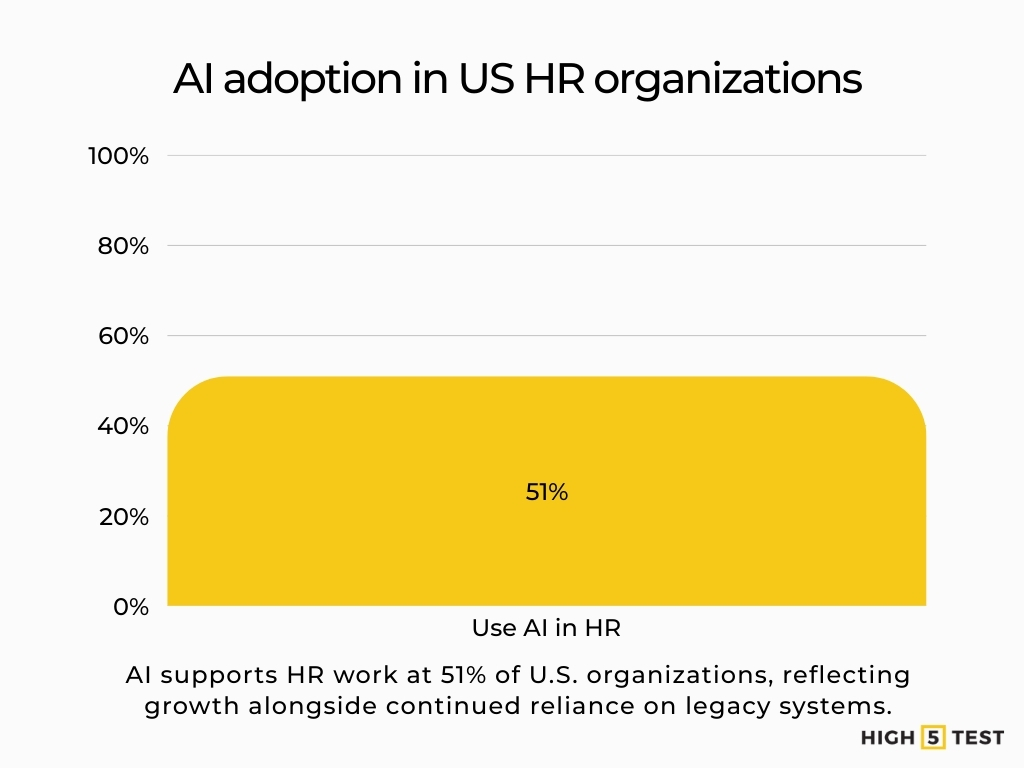
51% of U.S. organizations use AI to support HR-related activities. This shows AI has moved past pilot status for many employers. It also suggests that large groups still rely on traditional HR systems and manual workflows.
Source: SHRM
64% of organizations that use AI in HR apply it to recruiting, interviewing, or hiring, showing that talent acquisition is the primary entry point for AI adoption compared to learning, performance, or workforce planning.
Source: SHRM
47% of HR professionals say AI has become more of a priority in the past 12 months. This points to growing budget attention and stronger leadership interest during 2024. It also signals pressure to show results through time savings or quality gains.
Source: SHRM
Generative AI adoption among HR leaders
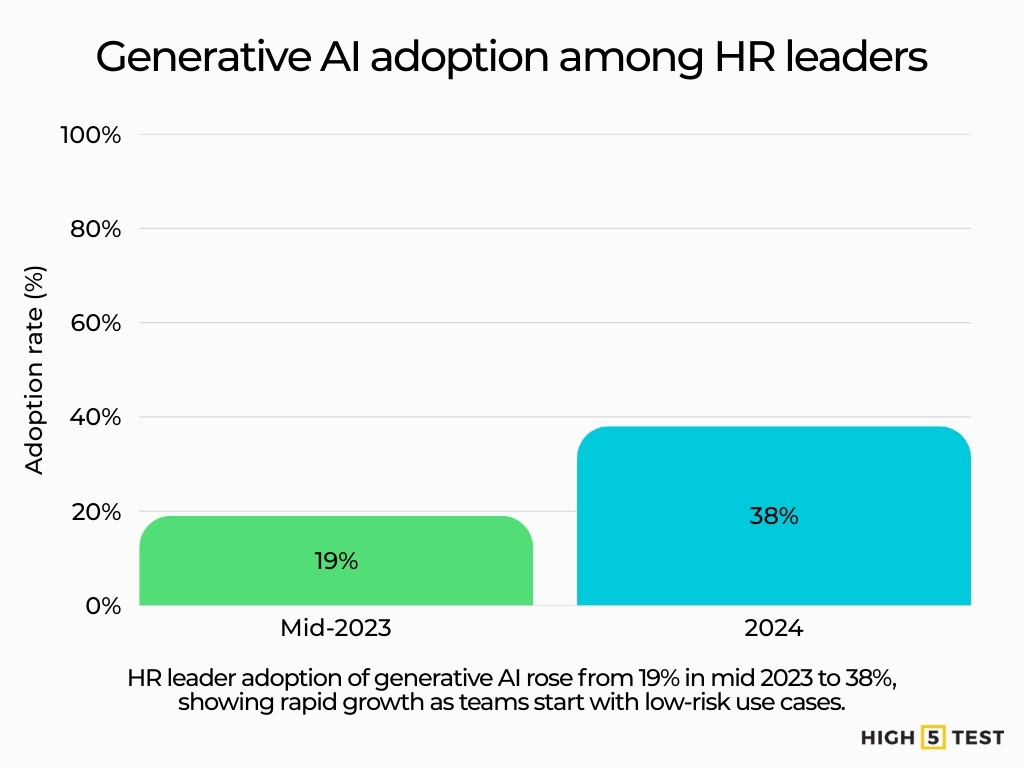
38% of HR leaders are piloting, planning, or implementing generative AI. This is up from 19 percent in mid 2023, which shows faster acceptance at the leadership level. Many teams start with narrow use cases to reduce risk.
Source: Gartner
41% of HR leaders prioritize GenAI specifically for recruiting tasks. Common uses include job description drafting and skills insights. These tasks feel safer because they support staff work instead of making candidate decisions.
Source: Gartner
Statistics on recruiters’ usage and productivity impact
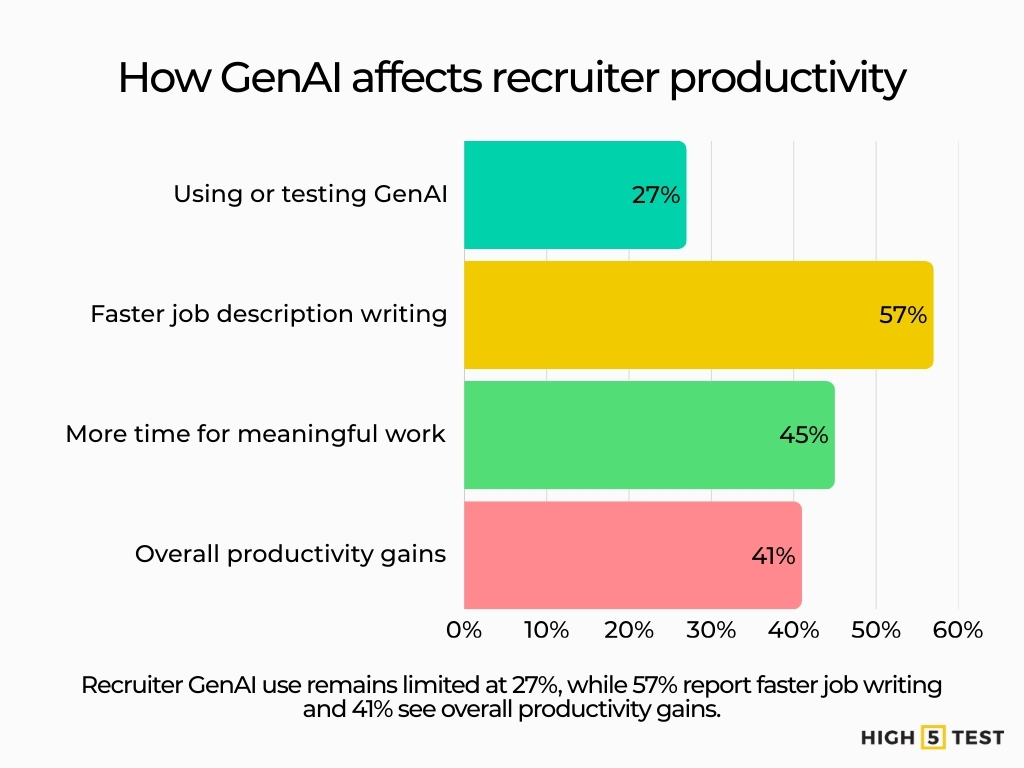
27% of talent professionals say they are actively using or experimenting with GenAI. Hands-on adoption is moving more slowly than leadership planning. Many recruiters want clearer policies and training before they rely on GenAI in live hiring.
57% of recruiters using GenAI report faster or easier job description writing. Text drafting often becomes the first win because it reduces repetitive writing. Teams still need review standards to keep language accurate and inclusive.
Source: LinkedIn
45% say GenAI frees up time for more meaningful recruiting work. This suggests AI shifts effort away from admin work and toward candidate conversations. Hiring teams can use that time to improve interview prep and follow-up quality.
41% of GenAI-using recruiters report overall productivity improvements. The primary return tends to be speed and throughput. Quality controls still matter, since faster workflows can also make mistakes faster.
Source: LinkedIn
Statistics on the most common AI recruiting use cases
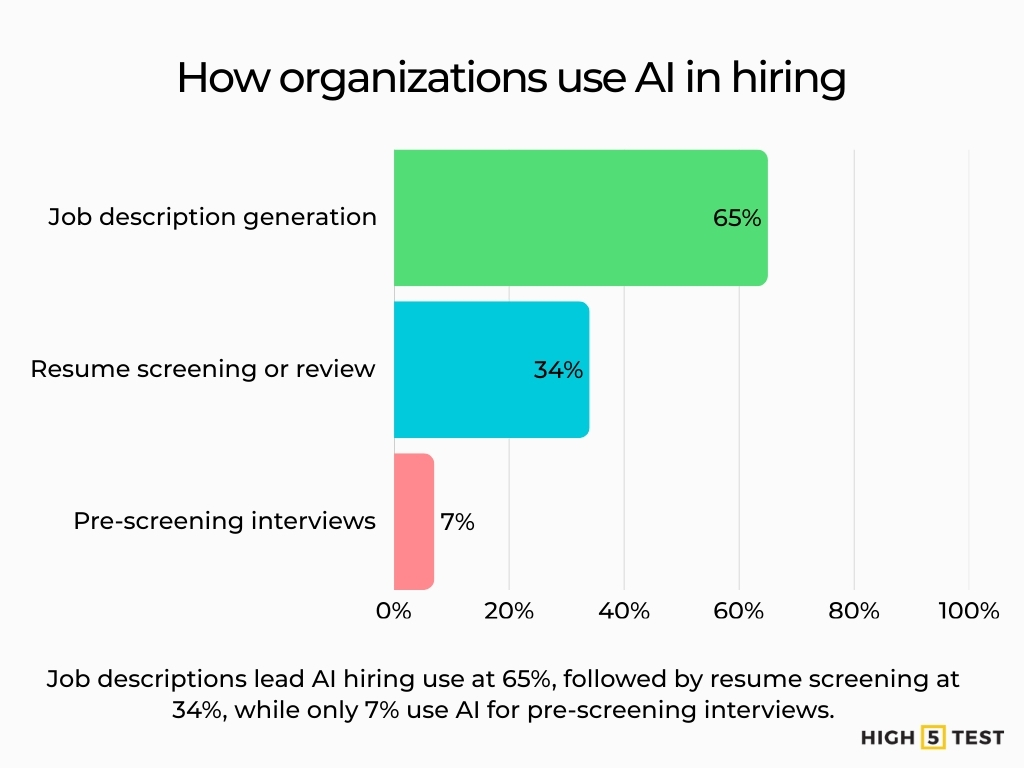
Nearly two-thirds (65%) of organizations using AI in hiring rely on it for job description generation. Employers often prefer assistive use cases that keep people in charge of decisions. This approach also helps standardize templates and reduce blank-page delays.
Source: SHRM
About one-third (34%) use AI to screen or review resumes. Resume screening shows moderate trust in algorithmic filtering. Many teams still add human review steps to catch false rejections and edge cases.
Source: SHRM
Only 7% use AI for pre-screening interviews. AI-led evaluation carries higher legal, bias, and candidate experience risk. Organizations tend to move more slowly in areas tied to direct assessment.
Source: SHRM
88% of organizations cite time savings and efficiency as the primary reason for using AI in recruiting. Teams often start with speed goals rather than strategy goals. A simple next step is to track quality metrics alongside speed, such as pass-through rates and candidate satisfaction.
Source: SHRM
Data on job seeker trust and sentiment toward AI hiring
Only 8% of U.S. job seekers believe AI makes hiring more fair. This signals a major credibility gap between employer intent and candidate perception. Clear communication about how AI is used can reduce suspicion.
Source: Greenhouse
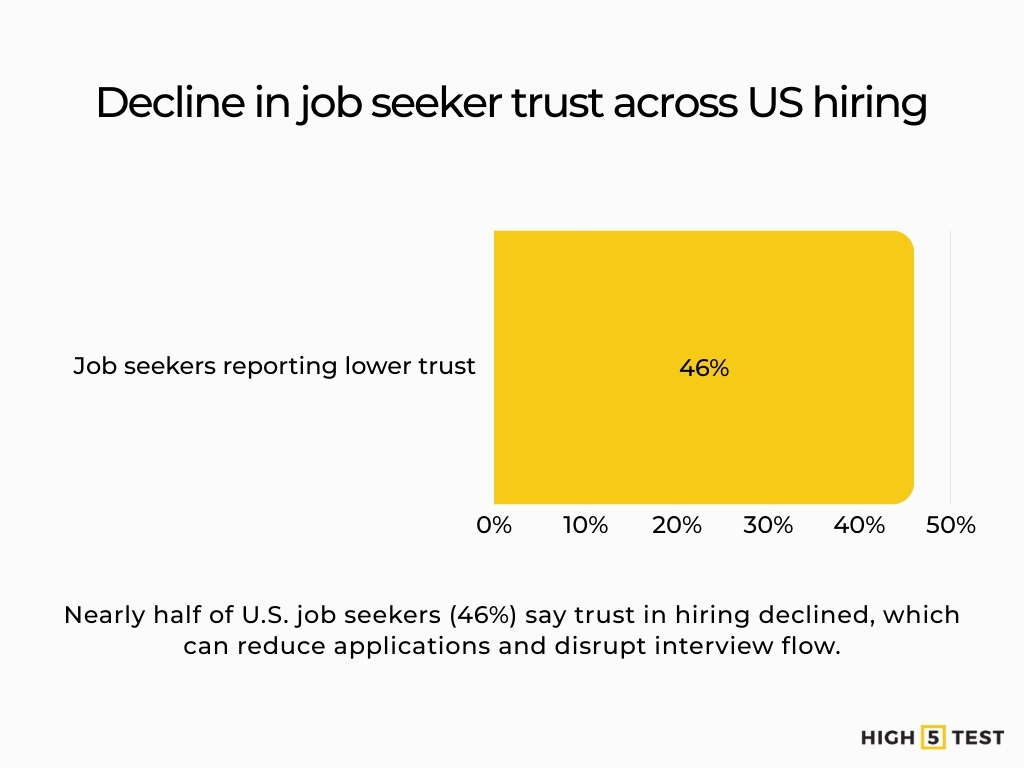
Almost one in every two (46%) of U.S. job seekers say their trust in hiring has declined over the past year. Declining trust can lower application completion rates and increase drop-off during interviews. Candidate experience work becomes more valuable in this environment.
Source: Greenhouse
42% of job seekers attribute declining trust specifically to AI. Automation gets blamed for opaque decisions and slow feedback loops. Faster, clearer status updates can counter that perception.
Source: Greenhouse
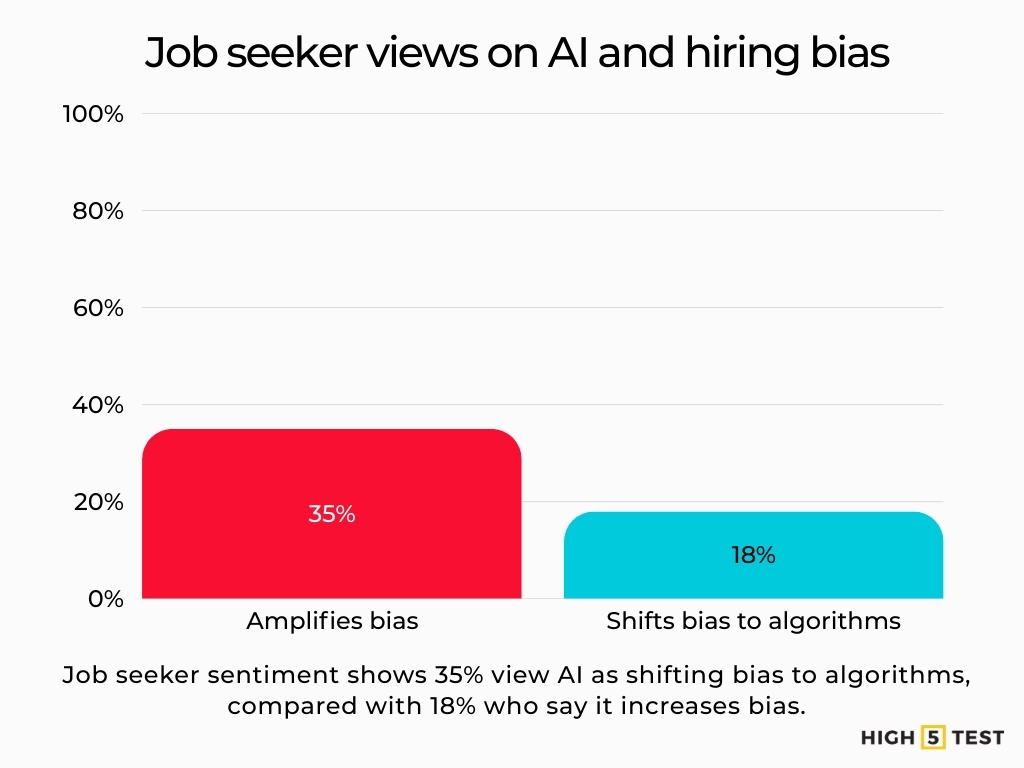
35% believe AI shifts bias from humans to algorithms, while 18% believe it amplifies bias, showing that ethical skepticism outweighs perceived fairness benefits.
Source: Greenhouse
Statistics on AI-driven application growth and inflation
91% of recruiters report encountering candidate deception. AI-written materials can inflate volume and reduce signal quality in applicant pools. Stronger screening questions and work samples can restore clarity.
Source: Greenhouse
34% of recruiters spend up to half their workweek filtering spam or low-quality applications. Some workload moved from sourcing to cleanup work. Teams can reduce that burden with tighter application gating and clearer minimum qualifications.
Source: Greenhouse
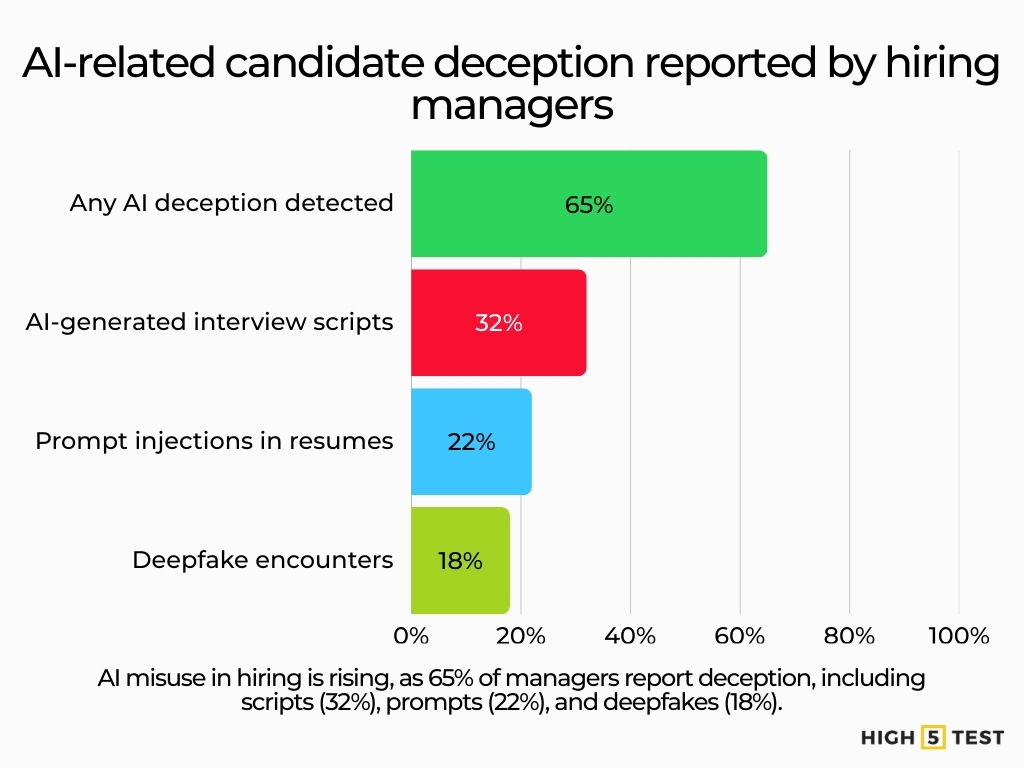
65% of hiring managers have caught candidates using AI deceptively, including 32% reading AI-generated scripts, hiding prompt injections in resumes (22%), and 18% encountering deepfakes, highlighting the emerging “AI arms race” between applicants and employers.
Source: Greenhouse
Statistics on AI exposure at the workforce level (US)
21% of U.S. workers say at least some of their work is done with AI, up from 16% in 2024. AI exposure is spreading beyond technical teams. Hiring teams may see more candidates referencing AI tools in portfolios and interviews.
Source: Pew Research Center
Data on AI visibility in job postings
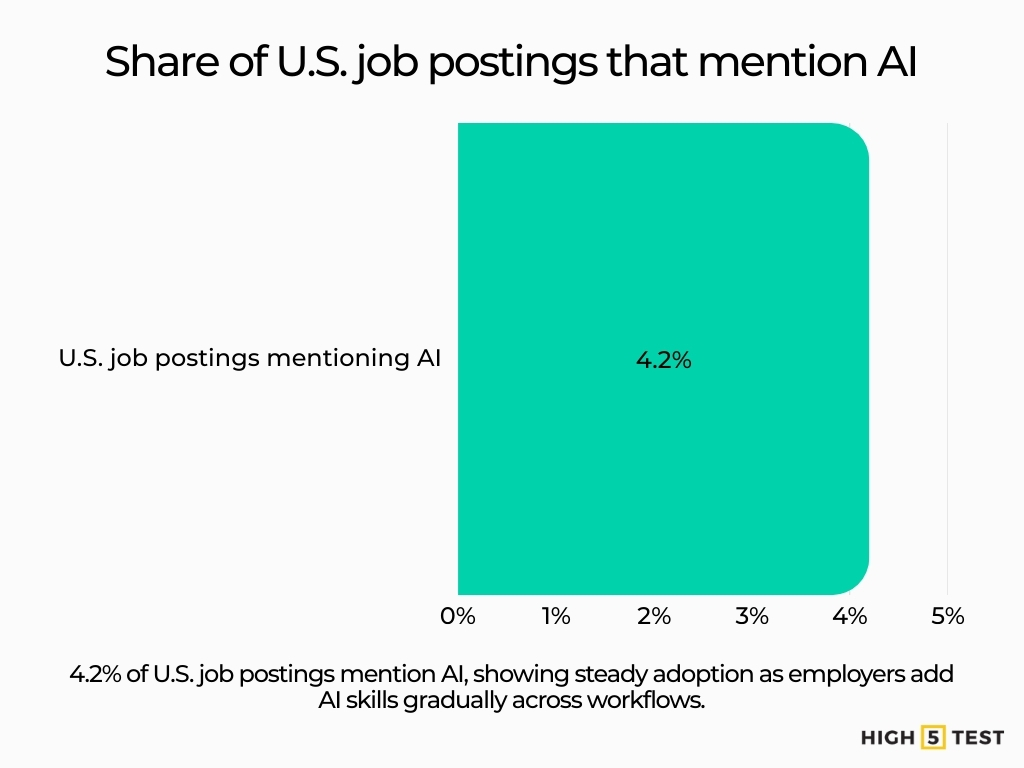
4.2% of U.S. job postings mentioned AI terms by December 2025. Growth looks steady rather than explosive. This suggests employers add AI requirements slowly as tools become standard in more workflows.
Source: Indeed Hiring Lab
Approximately 9% of HR job postings mention AI. HR teams face rising expectations to select, manage, or evaluate AI hiring tools. Training plans should include tool literacy and compliance basics for HR staff.
Source: Indeed Hiring Lab
Conclusion
AI is now part of daily recruiting operations for many US employers in 2024 and 2025. The data shows growing adoption in sourcing support, job description drafting, and resume review. Candidate trust and bias concerns still limit acceptance, especially for assessment steps.
Recruiting teams see the strongest gains when AI supports staff work and keeps human decision ownership clear. Transparency helps reduce candidate suspicion. Strong governance also helps protect quality as volume grows. Teams that pair speed metrics with quality metrics will make better tool decisions over time.
FAQ
What percentage of U.S. organizations are using AI in HR?
51% of organizations use AI to support HR-related activities. This figure signals broad adoption with plenty of room for growth. Teams that start now can gain a process advantage through better workflows and measurement.
What are the most common AI recruiting tasks?
Job description generation (~2 in 3) and resume screening (~1 in 3) are among the most common AI recruiting use cases reported by organizations using AI in hiring workflows. These tasks are easier to standardize and audit. Candidate-facing evaluation steps tend to see slower adoption.
Are workers using AI more in 2025 than in 2024?
Yes. 21% of U.S. workers said at least some of their work is done with AI in September 2025, up from 16% in 2024. This trend increases the odds that candidates expect AI-friendly processes and faster response times. Hiring teams can meet that expectation with clearer timelines and updates.