
If you’re searching for a personality test, chances are you’re not looking for a label — you’re looking for understanding. You want language for things you already sense about yourself. Patterns you keep repeating. Strengths you rely on without realizing it. Questions like “Why do I react this way?” or “What actually motivates me?”
The best personality tests for self‑insight don’t try to measure you against a standard. They help you notice yourself more clearly. Some focus on strengths, others on emotional patterns, traits, or values. None of them tells the full story on their own, but each offers a different angle on who you are.
Below is a carefully chosen selection of free personality tests that work especially well for personal reflection and self‑discovery. These aren’t designed for hiring decisions or workplace evaluation. They’re tools you can use privately, at your own pace, to better understand how you think, feel, and move through the world.
![5 Best Personality Tests You Can Take Online Free and Paid [2023]](https://high5test.com/wp-content/uploads/2023/07/5-Best-Personality-Tests-You-Can-Take-Online-Free-and-Paid-2023.jpg)
The Best Free Personality Tests for Self-Insight
Before diving into each assessment in detail, it helps to have a simple overview of what each personality test is actually measuring — and how people typically use it for self-insight.
- The HIGH5 Strengths Test focuses on your natural strengths and energizing behaviors. It’s commonly used for self-confidence, direction, and understanding what you do best when you’re at your natural best.
- 16 Personalities Test (The Myers-Briggs Type Indicator) looks at personality preferences — how you take in information, make decisions, and relate to the world. People often use it to better understand their inner wiring and differences in perspective.
- The Enneagram Personality Test explores core motivations, fears, and emotional patterns. It’s widely used for deep self-reflection, emotional awareness, and long-term personal growth.
- The Big Five Personality Test measures five broad personality traits that shape behavior and temperament. It’s often used to gain a realistic, research-backed snapshot of personality tendencies.
- The DISC Personality Test focuses on behavioral and communication styles. While commonly associated with work settings, it can still be used personally to reflect on how you respond to people and situations.
- The HEXACO Personality Inventory expands on trait-based models by adding a strong values dimension. People often turn to it to better understand honesty, humility, emotionality, and ethical tendencies.
- The Emotional Intelligence Test looks at how you recognize, manage, and respond to emotions — both your own and others’. It’s typically used to increase emotional awareness and improve relationships.
#1. HIGH5 Strengths Test
The HIGH5 Strengths Test takes a refreshingly positive approach to personality. Instead of asking what’s wrong or what needs fixing, it focuses on what already works – the strengths that come naturally to you and give you energy.
Often described as a strengths-based personality test, HIGH5 is designed to help you understand how you operate at your best. Rather than placing you into a rigid type, it highlights patterns of behavior and motivation that feel authentic and sustainable.
HIGH5 measures 20 strengths across 4 categories:
- Doing (Believer, Deliverer, Focus Expert, Problem Solver, and Time Keeper)
- Feeling (Chameleon, Coach, Empathizer, Optimist, and Peace Keeper)
- Motivating (Catalyst, Commander, Self-Believer, Storyteller, and Winner)
- Thinking (Analyst, Brainstomer, Philomath, Strategist, and Thinker)
Each person receives a ranked list of strengths, with a strong focus on what energizes you and helps you perform at your best.
When you receive your results, you’ll see your top five strengths explained in everyday language. The report helps you recognize situations where these strengths show up effortlessly, as well as moments where they might be underused or misunderstood. Many people describe the experience as grounding — like finally having words for what they’ve always felt but couldn’t articulate.
What’s important to know is that HIGH5 isn’t about performance or comparison. It’s meant for self-awareness and confidence, helping you see your natural tendencies without judgment. A free version is available, with the option to unlock deeper insights if you want to explore further.
From a reliability perspective, HIGH5 draws on the strengths-based psychology and positive psychology research. It’s not a clinical assessment, but it’s consistent and practical.
One limitation is that it doesn’t deeply explore emotional wounds or inner fears. Instead, it stays focused on what energizes and empowers you. For many people, that’s exactly what makes it useful.
My results are: Analyst, Strategist, Self-Believer, Winner, and Philomath.
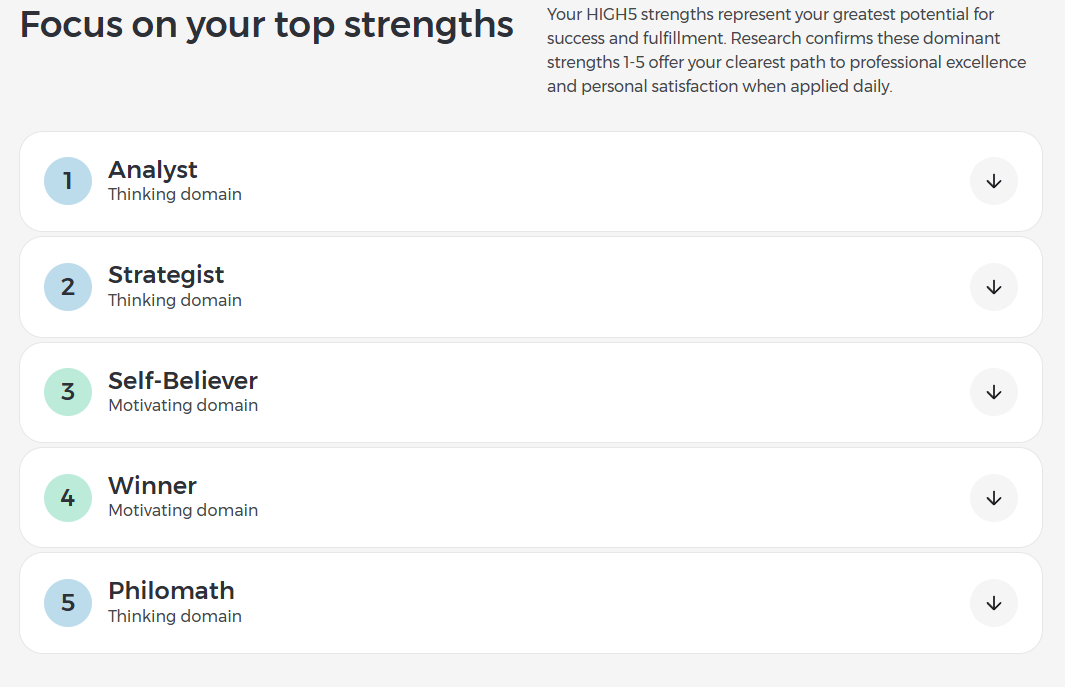
Here’s what is important for this test:
- Purpose: I use HIGH5 to uncover my top 5 strengths (or the full ranking of all 20 in the paid report). When I consciously apply these strengths in my life, it helps me feel more confident, capable, and aligned.
- Format: I answer 120 questions, which usually takes me around 15–20 minutes.
- Reliability: I see this as a reliable self-awareness tool grounded in strengths and positive psychology. Since it’s relatively new, it continues to evolve and improve.
- Costs: I can take the test for free to see my top 5 strengths. If I want deeper insights and practical ideas, I can upgrade to the full report.
One limitation that I see is that it doesn’t deeply explore emotional wounds or inner fears. Instead, it stays focused on what energizes and empowers you. For many people, that’s exactly what makes it useful.
You can take the HIGH5 Strengths Test here: https://high5test.com/
#2 16 Personalities Test (MBTI)
The 16 Personalities Test, most commonly known today through the MBTI test, is one of the most recognizable personality frameworks in the world. People are often drawn to it because it offers something simple but compelling: a language for how you perceive the world and make decisions.
MBTI is built around four preference pairs, which combine into sixteen personality types. These pairs explore where you focus your energy, how you take in information, how you make decisions, and how you approach structure and flexibility.
Most online versions include 60–100 questions and take about 10–20 minutes to complete. The questions ask you to choose between two preferences or rate how strongly you relate to certain statements. Your responses are then grouped into one of the 16 personality types, each represented by a four-letter code.
MBTI measures personality preferences across 4 dimensions, forming 16 personality types:
- Extraversion (E) / Introversion (I) – where you direct your energy
- Sensing (S) / Intuition (N) – how you take in information
- Thinking (T) / Feeling (F) – how you make decisions
- Judging (J) / Perceiving (P) – how you approach structure and flexibility
The combination of these preferences results in 16 distinct personality types (e.g. INFP, ESTJ).
What many people appreciate about the MBTI is how intuitive it feels. Reading your type description can feel like being gently seen, especially when it puts words to long-standing preferences or inner conflicts.
Here’s what you should know for this test:
- Purpose: Helps you understand your personality preferences and groups you into one of 16 types (plus an Identity layer), giving you language for how you take in information, make decisions, and relate to the world.
- Format: 16Personalities describes its test as taking about 10 minutes and scoring you across five personality aspects: Energy, Mind, Nature, Tactics, and Identity.
- Reliability: Best used as a reflective framework. 16Personalities publishes information on its theory and statistical verification of its model.
- Costs: Free results are available; premium reports are optional.
My results are ESTJ-T, aka Executive.
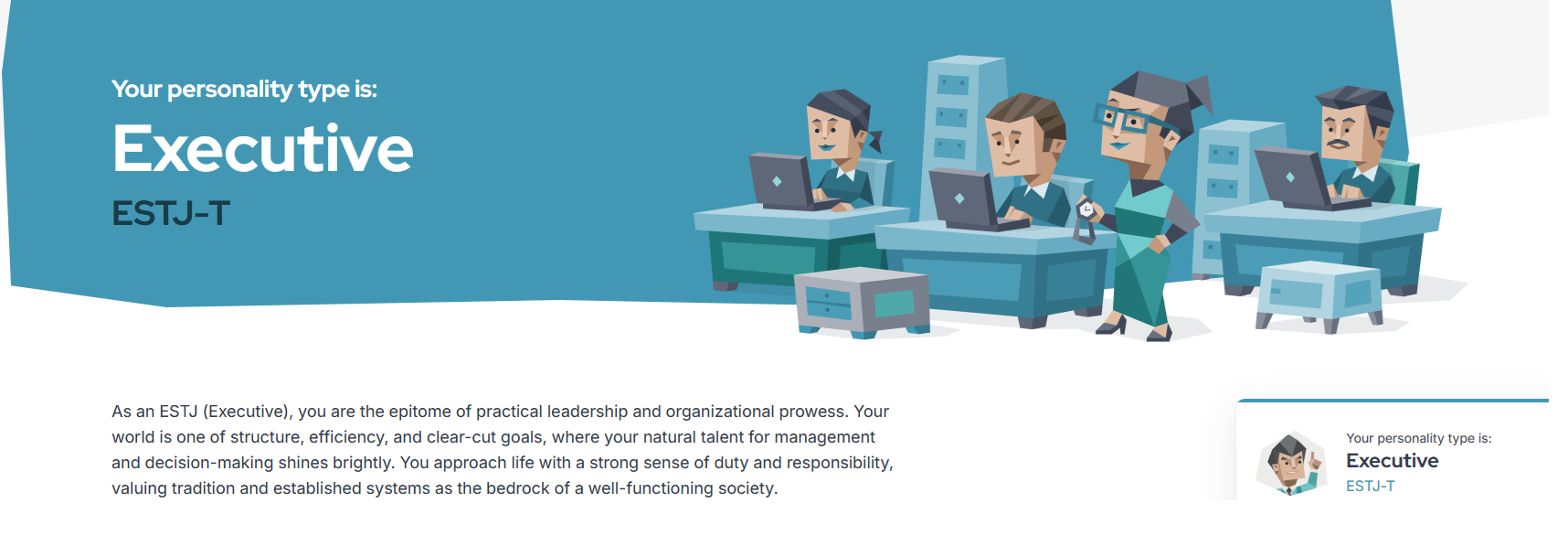
Official MBTI assessments are paid and more structured. Its biggest limitation is rigidity, which means personality is more fluid than four letters can capture. Still, for many people, it provides a helpful lens for understanding their inner preferences and differences.
You can take the 16 Personalities version of the test here: https://www.16personalities.com/
#3 Enneagram Personality Test
If you’re less interested in what you do and more curious about why you do it, the Enneagram is one of the most revealing personality systems you can explore.
Eclectic Energies offers two free Enneagram options, and they work a little differently.
The Classical Enneagram test starts with up to nine questions per page (one for each type) and then gradually reduces the number of types it asks about as your answers make certain types unlikely. Because it’s adaptive, the total length varies — the site notes a minimum of 78 questions and a maximum of 126.
The Enneagram measures 9 core personality types based on motivation and fear:
- Each type reflects a core desire, core fear, and coping strategy
- The system also explores:
- Stress and growth patterns
- Wings (adjacent type influences)
- Emotional and relational dynamics
Rather than traits or behaviors, the Enneagram focuses on why you think, feel, and act the way you do.
There’s also an Enneagram test with an instinctual variant, which uses pairs of traits to rate and is designed to be quicker, while also indicating your instinctual subtype.
This is a test that rewards honesty and reflection. If you rush it, it’s easy to get results that feel “off.” What’s important to know is that the Enneagram works best when you slow down with it. Quick results can be misleading, and many people mistype themselves at first. The real value comes from reading, reflecting, and noticing yourself in everyday situations.
People usually turn to the Enneagram for deep self-awareness, emotional insight, and long-term personal growth. The tests themselves are typically online questionnaires with reflective, agreement-based questions. Many versions are free, while more detailed interpretations or coaching resources may cost extra.
Here’s what is important for this test:
- Purpose: I use this test to explore my core motivations, fears, and emotional patterns — the deeper reasons behind my behavior.
- Format: The Classical test adapts as I answer questions and usually falls between 78 and 126 questions, depending on how my responses narrow down my type.
- Reliability: I find it insightful for self-reflection, but it works best when I answer slowly and honestly rather than rushing.
- Costs: I can take the test and view my results for free.
My result is type 8 with balanced wings.
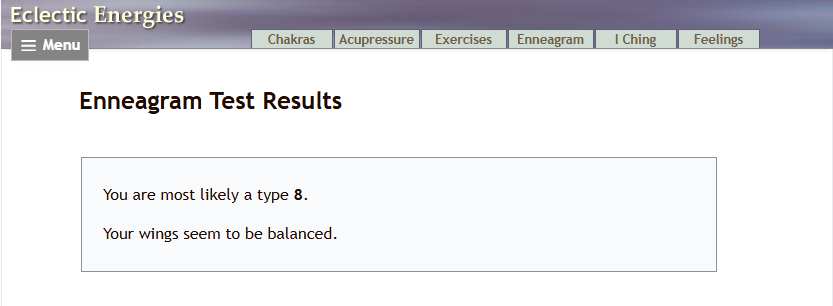
From a scientific standpoint, the Enneagram isn’t a clinical diagnostic tool. Its strength lies more in insight than measurement. For some, it can feel abstract or intense, but for others, it becomes a powerful framework for understanding themselves on a deeper level.
You can try a free Enneagram test here: https://www.eclecticenergies.com/enneagram/test
#4 Big Five Personality Test
The Big Five Personality Test takes a very different approach from type-based systems. Instead of telling you who you are, it shows you how your personality traits are distributed.
When I took Truity’s Big Five test, what stood out immediately was how grounded it felt. There was no attempt to put me in a box or give me an identity label. Instead, it quietly reflected back patterns I could already recognize in my behavior — how I approach responsibility, how I react emotionally, and how open I am to new experiences.
Truity’s Big Five test consists of 60 questions and takes about 5–10 minutes to complete. I rated how much I agreed or disagreed with each statement, and my responses were scored across the five core traits: openness, conscientiousness, extraversion, agreeableness, and neuroticism.
This particular version of the Big Five used by Truity consists of 60 questions that take most people about 10–12 minutes to complete. You’ll be prompted to indicate how much each statement feels like you, typically on a scale from “strongly disagree” to “strongly agree.” Your responses are translated into scores across the five core traits:
- Openness to Experience — your curiosity, imagination, and openness to new ideas
- Conscientiousness — your organization, reliability, and follow-through
- Extraversion — your energy in social settings and how you draw energy from others
- Agreeableness — your tendency toward warmth, cooperation, and empathy
- Neuroticism — your emotional reactivity and sensitivity to stress
Rather than producing a type, the test placed me on a spectrum for each trait. That made the results feel realistic and flexible, more like a personality snapshot than a verdict.
My best result or score was in conscientiousness.
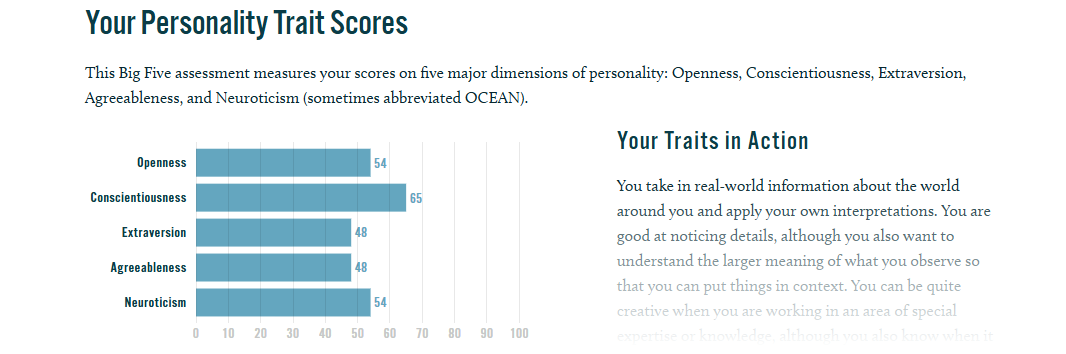
I find this test especially useful when I want honest self-awareness without storytelling. It’s ideal if you’re trying to understand long-term tendencies, emotional patterns, or why certain habits keep repeating.
You can take a free Big Five test here: https://www.truity.com/test/big-five-personality-test
#5 DISC Personality Test
The DISC Personality Test focuses on how you tend to act and communicate, especially in response to other people.
When I took the DISC test, I noticed that it felt very practical and immediate. It didn’t ask me to analyze my inner world; instead, it reflected how I behave in real interactions, especially under pressure or in group settings.
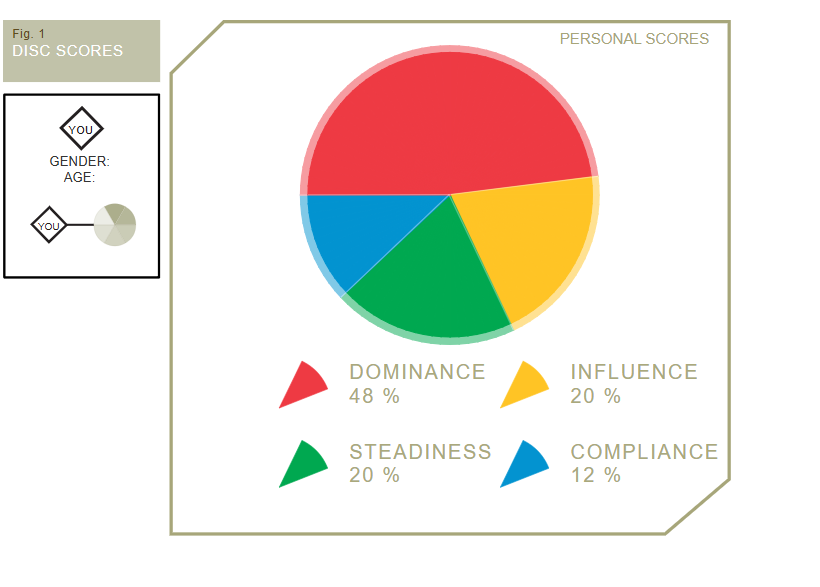
The 123test DISC assessment contains 28 groups of four statements. For each group, I chose one statement that felt most like me and one that felt least like me. The whole process took about 5–10 minutes, and the results were mapped across the four DISC styles.
DISC measures 4 primary behavioral styles:
- Dominance – how you respond to challenges
- Influence – how you interact and persuade
- Steadiness – how you handle pace and stability
- Conscientiousness – how you approach rules, accuracy, and structure
Results typically show a blend of styles, reflecting observable behavior rather than inner motivation.
My DISC style is Dominance. Within the Dominance quadrant, I fall towards Influence. So, my DISC type is Di.
What I appreciate about DISC is how clearly it highlights behavioral patterns. It doesn’t explain why those patterns exist, but it does make them visible.
- Purpose: I use DISC to better understand my behavioral and communication style, especially how I respond to people and situations.
- Format: I work through 28 groups of statements, choosing what feels most and least like me, which takes about 5–10 minutes.
- Reliability: I find it useful for behavioral awareness, though it doesn’t dive deeply into emotions or motivation.
- Costs: I can take the test and see my results for free.
I find DISC most useful when I want to understand how I come across to others, especially in communication, conflict, or collaboration. It’s not deep emotional work — but as a mirror for interaction habits, it’s surprisingly revealing.
You can try a free DISC test here: https://www.123test.com/disc-personality-test/
#6 HEXACO Personality Inventory
If you’re drawn to personality tests that feel more grounded and value-aware, the HEXACO model offers a thoughtful extension of the classic trait approach.
When I explored HEXACO, it felt noticeably more serious and analytical than most popular personality tests. This isn’t a framework that tries to motivate or reassure — it describes patterns as they are, especially around values and ethics.
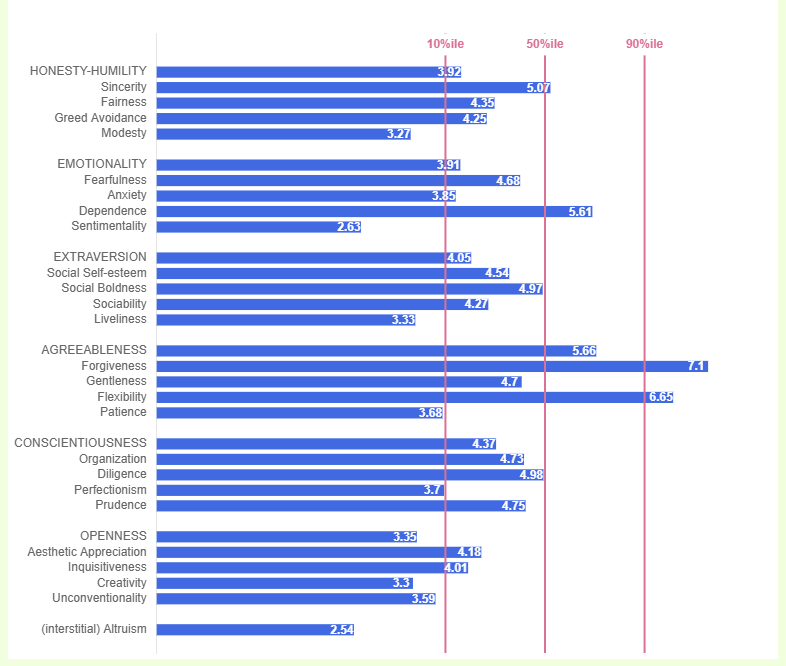
The HEXACO-PI-R is commonly taken in either a 100-item version or a shorter 60-item version. I rated how much each statement applied to me, and my responses were scored across six traits, including the distinctive honesty–humility dimension. The full version took me about 20 minutes to complete.
What stood out most was the focus on values. HEXACO highlights tendencies around fairness, sincerity, and modesty in a way that other models often ignore.
HEXACO measures 6 personality traits:
- Honesty–Humility – sincerity, fairness, modesty
- Emotionality – emotional sensitivity and attachment
- Extraversion – sociability and social confidence
- Agreeableness – patience, forgiveness, tolerance
- Conscientiousness – organization and self-discipline
- Openness to Experience – curiosity and creativity
HEXACO extends the Big Five by adding Honesty–Humility, which captures ethical and value-based tendencies.
I find HEXACO most useful when I want a clear-eyed, research-driven view of my personality, especially around integrity, emotional sensitivity, and consistency. It’s less about inspiration — and more about understanding myself without filters.
Here is what you need to know about the HEXACO test:
- Purpose: I use HEXACO to understand my personality traits with an added focus on values like honesty and humility.
- Format: I can take the 100-item version (about 20 minutes) or the shorter 60-item version (around 12 minutes).
- Reliability: I see it as a solid, research-backed trait model that’s widely used in academic psychology.
- Costs: The inventory itself is freely available through the HEXACO project, with online survey access provided via the official site.
My best score was in the domain Agreeableness, for Forgiveness and Flexibility.
You can explore a free HEXACO-based test here: https://hexaco.org/hexaco-online
#7 Emotional Intelligence Test
While traditional personality tests focus on traits and tendencies, Emotional Intelligence tests focus on how you relate to emotions, both your own and other people’s.
When I took the MindTools EQ test, it felt less like a personality assessment and more like a moment of self-check-in. The questions nudged me to notice how I actually respond to emotional situations, not how I’d like to think I do.
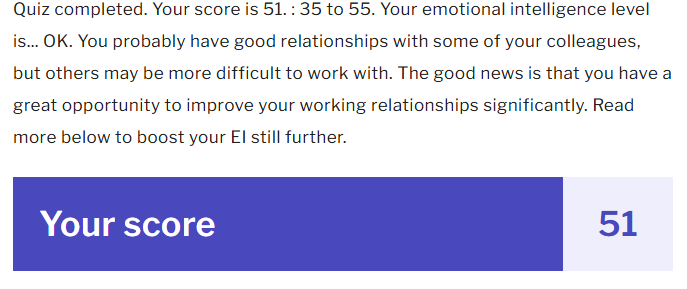
The MindTools EQ self-assessment is a 15-statement quiz where I rated how often each statement applied to me. It only took a few minutes, but the results were grouped into areas like self-awareness, self-regulation, empathy, and social skills.
Emotional Intelligence tests typically measure 4 core emotional skill areas:
- Self-awareness – recognizing your own emotions
- Self-regulation – managing emotional responses
- Empathy / Social awareness – understanding others’ emotions
- Relationship management – navigating social and emotional situations
Unlike personality traits, EQ focuses on skills that can be learned and developed over time.
What makes EQ tests different is that the results don’t feel fixed. They reflect skills rather than traits — which means they can change with awareness and practice.
My result is 35 – 55, meaning my emotional intelligence level is ok.
Here are the important things for this test:
- Purpose: I use this EQ test to reflect on how well I recognize, manage, and respond to emotions in myself and others.
- Format: I answer 15 statements, rating how often each applies to me.
- Reliability: I treat it as a practical self-check rather than a definitive measure, knowing emotional skills can change over time.
- Costs: I can access the quiz online for free, with additional learning resources available through MindTools memberships.
I find emotional intelligence tests most useful when emotions feel like the missing piece — in relationships, stress, or communication. They don’t define who I am, but they do show me where growth is possible.
You can try a free Emotional Intelligence test here: https://www.mindtools.com/pages/article/ei-quiz.htm
Other personality tests you might’ve heard about
As you explore personality testing, you’ll likely come across a few other well-known names. While they may not always be the best starting point for personal self-insight, they each offer a slightly different lens on human behavior and character.
- The VIA Character Strengths assessment focuses on moral and character strengths such as kindness, curiosity, gratitude, and perseverance. Rather than describing personality traits, it highlights virtues and values. Many people find it uplifting and affirming, especially when they want to reconnect with what feels meaningful rather than analytical.
- True Colors is a simplified personality framework that groups people into four color-based styles. It’s easy to understand and is often used in workshops or group settings. While it can spark quick insights, it tends to stay at a surface level and works best as an introduction rather than a deep exploration.
- The Revised NEO Personality Inventory (NEO-PI-R) is a more formal, clinical version of the Big Five model. It offers detailed trait analysis and is often used in academic or psychological contexts. For personal exploration, it can feel thorough but also dense and technical.
- The Hogan Development Survey looks at personality traits under stress and pressure. It’s designed primarily for organizational and leadership contexts, focusing on derailers rather than growth. While insightful, it’s less suited for gentle self-reflection or curiosity-driven exploration.
- The Eysenck Personality Inventory is one of the earlier trait-based models, focusing mainly on extraversion, neuroticism, and psychoticism. Historically important, it’s less commonly used today for personal insight due to its limited scope.
- The Keirsey Temperament Sorter builds on similar ideas to Myers–Briggs, grouping personality into four temperaments. It can be helpful for broad self-understanding, but it often overlaps with MBTI-style insights rather than adding something entirely new.
- Finally, the Personality Assessment Inventory (PAI) is a clinical psychological tool used by professionals to assess mental health patterns. It’s not intended for casual self-discovery and is best understood as part of a formal psychological evaluation.
How to use your personality test results
Taking a personality test is only the beginning. But do not forget the fact that an online assessment doesn’t define you. The real value comes from how you sit with the results afterward — not as labels to live by, but as invitations to notice yourself more clearly.
Start with self-awareness. Pay attention to what resonates and what feels slightly uncomfortable. Often, the most useful insights are the ones that gently challenge how you see yourself.
Use your results as a guide for clarity rather than certainty. They can help you recognize patterns, strengths, and tendencies that influence your next steps — whether that’s personal growth, relationships, or life decisions.
Personality insights can also improve how you communicate. When you understand your own preferences and reactions, it becomes easier to express yourself clearly and interpret others with more patience.
Decision-making is another area where personality awareness quietly helps. Knowing how you process information, handle emotions, or respond to stress can bring more confidence and intention into everyday choices.
Most importantly, treat personality testing as an ongoing conversation with yourself. Reflect on the results, explore how they show up in real life, and stay curious. You’re not meant to fit into a framework — the framework is simply there to help you understand yourself a little better.
Pro Tip From HIGH5
If you’re looking to gain clarity on your innate talents and how to capitalize on them for greater success and life satisfaction, consider taking a strengths-based assessment like the HIGH5. Understanding and strategically applying your strengths can unlock new levels of motivation, confidence and achievement.
Final thoughts
No personality test can fully capture who you are and that’s not the point. The real value lies in how these tools help you pause, reflect, and notice patterns that usually stay in the background of everyday life.
Some tests offer clarity, others offer language, and a few offer deep emotional insight. You don’t need to take all of them. Start with the one that matches what you’re most curious about right now: your strengths, your motivations, your behavior, or your emotions. Used thoughtfully, personality tests aren’t answers. They’re conversations with yourself — and sometimes, that’s exactly where meaningful change begins.