Understanding today’s workplace personality creates an advantage. Remote, hybrid, and onsite teams include different preferences for communication, energy, and collaboration. When leaders and professionals decode those differences thoughtfully, they reduce friction, increase cohesion, and improve results.
In this guide, you will learn:
- What workplace personality means through the trait and strengths lenses
- How personality shows up in remote, hybrid, and onsite settings
- How to adapt leadership to different personalities
- How to use tools like HIGH5 to map team strengths
- Simple steps to put insights into practice

Why personality matters
Personality influences how people think, act, respond to stress, communicate, and learn. In team contexts, differences can:
- Accelerate or slow down communication
- Create tension or synergy in decision-making
- Influence what types of work energize or drain people
- Affect motivation, retention, and engagement
Treat personality as a lens for tailoring leadership, processes, and norms.
Two complementary lenses: Traits and strengths
To map personality well, use two approaches together:
- Trait/spectrum models – like the Big Five (OCEAN). These highlight underlying tendencies and where people fall on continuums.
- Strengths-based models – like HIGH5, which identify what energizes someone, their natural “top” strengths, and how to leverage them positively.
Trait insight gives structure. Strengths give a positive path to action. In this article, we’ll integrate both.
The Big Five (OCEAN) model in the workplace
The Big Five is a well-studied framework in work psychology. Each person sits on five dimensions, not fixed types.
| Trait | High expression | Low expression | Implications in Work |
| Openness to Experience | Curious, imaginative, flexible, and enjoys novelty | Preference for routine, comfortable with familiar | Supports innovation or consistency based on the level |
| Conscientiousness | Disciplined, organized, reliable, goal-oriented | More spontaneous, flexible, less structured | Predicts on-time delivery and follow-through |
| Extraversion | Sociable, talkative, energetic, assertive | Reserved, introverted, reflective | Drives discussion or brings depth and listening |
| Agreeableness | Cooperative, kind, empathic, harmonious | More skeptical, direct, competitive | Builds trust or challenges ideas as needed |
| Neuroticism (Emotional Stability inverse) | More sensitivity to stress, emotional volatility | Calm, resilient, emotionally steady | Signals burnout risk or resilience under pressure |
How to use Big Five insight as a leader
1. Assess and map trait distributions
You can run a validated Big Five assessment (or use partner tools) to see where your team lands in trait space.
2. Overlay with strengths
Compare trait results with HIGH5 strengths to spot reinforcement and gaps.
3. Design complementary teams
Balance groups if they cluster in one area, such as high openness and low conscientiousness.
4. Tailor communication and planning
- Conscientious colleagues want clear milestones and ownership.
- High openness values experimentation.
- Extraverts like discussion and visibility.
- More reserved people want time to reflect before making decisions.
- People with higher neuroticism benefit from clarity and buffers.
5. Monitor trait-linked risks
Watch for stress and burnout signals, especially under high load.
6. Iterate and revisit traits over time
Traits are stable, yet expression can shift with role or context changes.
Personality across remote, hybrid, and onsite work
When you view workplace personality through the Big Five lens (Openness, Conscientiousness, Extraversion, Agreeableness, Neuroticism), you can better anticipate how people tend to respond in different work modalities (onsite, remote, hybrid).
Below is a synthesized view of how these traits interact with each setting, with behavioral implications and leadership considerations.
1. Onsite or In-Person Settings
How traits tend to manifest
- Openness – comfortable with cross-team mixing, exposure to new stimuli, and changing context.
- Conscientiousness – appreciates structure, visible accountability, clearly defined routines, and deadlines.
- Extraversion – thrives in face-to-face dialogue, hallway chats, brainstorming sessions, and spontaneous interaction.
- Agreeableness – can read social cues, mediate tension, maintain harmony, collaborate in close quarters
- Neuroticism (lower emotional stability) – may feel more stress in loud, dynamic environments, but immediate social support may buffer it.
Risks and fixes
- High extraversion may dominate conversation, overshadowing more reserved voices.
- High openness might chafe against rigid routines.
- Highly conscientious folks might become overly perfectionistic under social pressure
- More emotionally sensitive team members may struggle with noise and unexpected interactions
Leader strategies onsite
- Mix meeting formats (small groups, silent reflection, breakout groups)
- Provide “quiet zones” or retreat spaces
- Use structured facilitation (balanced airtime, rotation of speakers)
- Encourage social but purposeful interaction (networking with an agenda, cross-pollination)
2. Remote or Fully Virtual Settings
How traits tend to manifest
- Openness – adaptability to new tools, flexibility in workflows, creative problem-solving.
- Conscientiousness – shines in remote contexts; self-discipline, structure, follow-through make remote work more sustainable (and research supports this).
- Extraversion – may decline in energy, experience social isolation, miss in-person cues (leading to a drop in engagement).
- Agreeableness – supports trust, collaborative tone, cooperative behavior in asynchronous settings.
- Neuroticism – a higher risk factor for remote work exhaustion, increased emotional strain, and ambiguity stress.
What the research says
- A study of work exhaustion found that neuroticism predicts higher exhaustion, while conscientiousness and agreeableness act as protective traits.
- In remote settings, extraversion’s effect is more fragile. Extraverts may outperform in the office but perform less well remotely.
- Another recent study found that openness and conscientiousness positively predict remote job performance.
Risks and fixes
- Extraverts may feel disconnected: schedule social check-ins, informal sessions, buddy calls.
- Highly neurotic individuals benefit from clarity, well-defined boundaries, and mental health support.
- Those lower in conscientiousness may struggle without structure; introduce milestones, visibility, and reminders.
- Encourage asynchronous communication norms, documented processes, and shared visibility.
3. Hybrid Settings
Hybrid settings are especially challenging because they blend stressors and advantages of both onsite and remote work. Traits that function well in one mode might struggle in the other, creating tension or “trait conflict.”
Trait dynamics in hybrid mode
- Openness – tends to flex better between environments
- Conscientiousness – may feel destabilized by fluctuating routines or shifting expectations
- Extraversion – may push for more in-office days, causing perceptions of inequality
- Agreeableness – may absorb tensions between “in” vs “out” groups
- Neuroticism – amplified uncertainty around fairness, visibility, and belonging
Risks and fixes
- Run inclusive hybrid meetings with remote-first habits.
- Team norms may feel inconsistent across days, causing confusion.
- Some team members might feel advantaged/disadvantaged depending on who’s onsite – mitigate via rotation, equitable visibility.
- Trait-based preferences may implicitly guide participation (e.g., extravert demands in-person brainstorms, introverts avoid onsite days).
Leader strategies in a hybrid
- Define clear hybrid norms (e.g., always include remote participants equally)
- Rotate on-site days so no one faction consistently dominates
- Use structured agendas, remote facilitation tools (shared docs, virtual whiteboards)
- Run retrospectives about hybrid friction and adjust norms
- Be transparent about the criteria for who comes in and when
Spotting personality patterns and archetypes
Using mini-profiles (e.g., “Energizer,” “Reflector,” “Analyzer,” “Harmonizer”) can help your readers quickly relate to patterns of behavior.
Below are archetypes along with loose mappings to Big Five trait ranges, to enrich the descriptions and make them more predictive. Use them as guides, not labels.
| Archetype / Persona | Core Behavioral Cues | Strengths / Contribution | Possible Pitfalls | Big Five Trait Mapping (loose) |
| Energizer / Connector | Initiates conversation, bridges people, lively in group settings | Builds networks, morale, idea flow, and social cohesion | Can dominate, interrupt others, distract, overlook detail | High Extraversion, moderate to high Openness, moderate Agreeableness |
| Reflector / Observer | Listens first, thinks before speaking, absorbs input, asks probing questions | Brings insight, catches blind spots, and provides thoughtful feedback | Slow to respond, seems quiet, less visible, may be overshadowed | Lower to moderate Extraversion, often moderate Openness, moderate Conscientiousness |
| Analyzer / Planner | Structures tasks, divides work, tracks milestones, seeks clarity | Execution, consistency, risk mitigation, quality | Can resist change, get stuck in planning, and are slower in ambiguous spaces | High Conscientiousness, moderate Openness (for adaptation), lower Neuroticism |
| Harmonizer / Diplomat | Mediates tension, cares for relationships, and reads emotional cues | Conflict mediator, maintains team climate, sensitive observer | May avoid tough conversations, hold back feedback, and delay decisions | High Agreeableness, moderate Emotional Stability (low neuroticism) |
How to use archetypes
- Observation and journaling: Watch team meetings or async communications – who speaks first, who holds back, who seeks structure, who jumps in socially.
- Trait alignment: Use Big Five snapshots (if available) to validate or nuance the archetype – e.g., someone you think is “Energizer” might score lower in extraversion but have a HIGH5 “Connector” strength.
- Pairing or teaming: Mix archetypes intentionally (e.g., Energizer + Analyzer, Reflector + Connector) to balance ideation and execution.
- Adapt your engagement:
- Energizers: invite them early in planning, give visible roles
- Reflectors: allow prep time, send agenda in advance
- Analyzers: lean into structured tasks, milestones, clarity
- Harmonizers: invite their feedback, facilitate safe zones for them to speak
What to keep in mind
- A person may embody multiple archetypes depending on context or project phase.
- Archetypes should be used as heuristics, not rigid identity labels.
- Always pair archetype insight with direct conversation and self-report.
Adapting leadership to the Big Five and Strengths
Here, you already have leadership adaptation approaches. You can augment them by referencing:
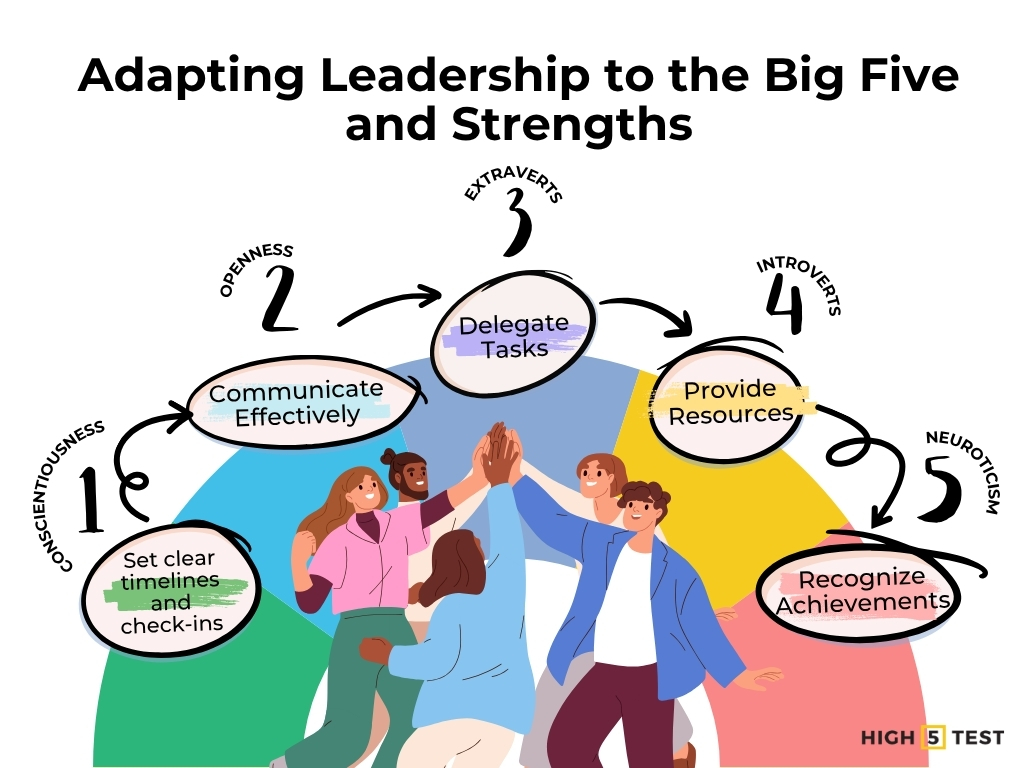
- For high conscientiousness, set clear timelines and check-ins.
- For high openness, create space for experiments.
- For extraverts, include opportunities for discussion and presentation.
- For introverts, share pre-reads and allow quiet thinking.
- For higher neuroticism, reduce ambiguity and provide buffers.
Using assessments: HIGH5 and trait integration
Run a Big Five assessment (here you can pick from the best Big Five assessments compared) and HIGH5 together. Use Big Five to read team tendencies, and use HIGH5 to activate day-to-day strengths.
- Collect Big Five and HIGH5 results.
- Share a simple team map. Highlight clusters, gaps, and likely friction zones.
- Agree on norms and handoffs that fit the mix.
- Revisit after major changes. Adjust roles, rituals, or support as needed.
FAQ
Isn’t the Big Five “cold” or too abstract?
While traits are generalized, they complement strengths models by offering a robust baseline. The combination gives both depth (traits) and positivity (strengths).
Can people change their trait scores?
Traits are relatively stable, but behaviors can shift. Also, in new roles or transitions, trait expression can flex. Use re-assessment after sizable changes.
What if a person’s traits and strengths seem misaligned?
That’s common. A person may have a trait tendency (e.g., moderate extraversion), but their top HIGH5 strength is “Connector.” Use the strengths as what energizes them, and the trait as a backdrop.
Are the Big Five and HIGH5 the same thing?
No. The Big Five measures broad trait tendencies. HIGH5 highlights top strengths that energize work. Use Big Five for pattern insight and HIGH5 for day-to-day actions.
How should we handle privacy and consent for assessments?
Explain the purpose and how the results will be used. Ask people to opt in. Store reports securely with limited access. Share group summaries in team settings. Keep personal details for one-to-one conversations.
Turn personality insight into strengths in action
Personality and strengths give teams a clear map. Use the Big Five to see patterns, and HIGH5 to activate what each person does best. Align communication, planning, and feedback with those insights. You get both the reliable backbone of trait psychology and the energizing, practical lens of strengths activation.
![Team Building Activities Definition & Lists [2021] High5](https://high5test.com/wp-content/uploads/2021/10/Team-Building-Activities-Definition-Lists-2021-High5-300x187.jpg)