Conflict with a co-worker is uncomfortable, but it doesn’t have to be destructive. When handled well, it can surface assumptions, build empathy, and improve results. This guide outlines a practical approach for addressing tension in any work environment. It also includes leadership advice and a team tool, the HIGH5 personality test, to help reduce future friction.

Early signs of conflict and why they matter
Unresolved conflict drains attention, lowers morale, and contributes to disengagement. It often starts small: unclear roles, competing priorities, different working styles, or tone gone wrong in chat or email.
In hybrid and remote teams, the lack of nonverbal cues and the “who was in the room” effect can make those misunderstandings escalate faster. Addressing issues early, informally if possible, keeps them contained and respectful. Formal processes like mediation or HR intervention are useful when informal steps don’t work.
Leaders should also remember conflict isn’t automatically bad. Research-based guidance encourages channeling disagreement into collaboration, not suppressing it. That means setting expectations, modeling psychological safety, and coaching people to resolve issues directly.
The price of avoiding tough conversations
- Lost productivity and time spent in side conversations
- Reduced trust and psychological safety
- Higher turnover or disengagement
- Faster escalation in hybrid or remote teams due to silence or unclear tone
But conflict isn’t always a villain. When addressed constructively, it can surface unspoken assumptions, spark innovation, and lead to better alignment.
Common triggers among co-workers
- Ambiguous roles or overlapping responsibilities
- Different work styles, pace, or communication preferences
- Personality clashes, emotional triggers
- Remote- or hybrid-specific triggers: tone ambiguity, visibility imbalance, asynchronous delays
Example: Alice sends a concise Slack message. Bob, reading it early in his morning timezone, interprets it as curt and assumes confrontation. He stops engaging. What began as a style mismatch becomes a cooling rift.
Types of conflict and escalation patterns
- Task conflict: disagreement about what needs to be done
- Process conflict: disagreement about how work should be done
- Relationship conflict: tension rooted in emotion or personality
Typical escalation path: disagreement → resentment → withdrawal or defensive escalation → breakdown. Warning signs include repeated miscommunication, defensiveness, side conversations, or silence.
Core mindsets and principles for productive conflict
Resolving conflict isn’t about “winning.” It’s about treating conflict as a problem to solve collaboratively. Here are foundational attitudes and skills to adopt.
1. Collaborative vs. adversarial mindset
- Focus on solving the issue, not defeating the person
- Use phrases like “Let’s figure this out together” instead of “You’re wrong.”
- Maintain respect, curiosity, and fairness
2. Emotional intelligence and regulation
- Recognize your emotional triggers and take a pause when needed
- Use “I statements”: “I feel X when Y happens, and I need Z”
- Practice active listening: paraphrase, ask clarifying questions, allow silence
3. Conversation ground rules
- Speak from observation, not judgment
- Avoid interrupting, personal attacks, or surprise accusations
- Agree on confidentiality and mutual respect
- Use open-ended questions: “Can you help me understand…” rather than “Why did you…”
4. Useful frameworks and models
- Use the Interest / Rights / Power (IRP) lens to explore conflict sources
- Follow a mediation structure: opening, sharing, issue-mapping, brainstorming, closing
- Role-play or rehearse tough conversations with a coach or AI practice tool
Tailoring strategies by work environment
Conflict resolution needs to match the work setting. What works in person may not translate in remote environments.
On-site/in-person teams
Strengths and risks: Nonverbal cues, physical proximity, and quick interventions can help. But arguments may escalate faster.
Tactics:
- Meet face-to-face in a neutral space
- Use a “walking meeting” to soften tension
- Use visual aids (whiteboard, sticky notes) to map perspectives
- Intervene early in less heated settings
Example: If the tone starts rising in person, pause and say, ‘Let’s take five, then come back and remember: we both care about the project’s success.’
Hybrid teams (mix of onsite + remote)
Common friction: Uneven access, “office bias,” and missed input from remote staff.
Tactics:
- Rotate who works onsite so all get exposure
- Institute hybrid meeting norms (camera on, hand signals, moderator ensures remote voice)
- Set “virtual open door” times for remote colleagues
- Create shared decision logs so no one misses out
- Hold face-to-face conflict debriefs when teams gather
Example: If decisions happen informally in person, remote staff can feel excluded. A shared notes doc makes decisions visible and keeps everyone aligned.
Fully remote teams
Main issues: No body language, tone misreadings, delayed replies, and scattered communication.
Tactics:
- Use video for emotionally charged talks
- Always follow up with a written summary
- Set clear guidelines for when to use chat, email, or video
- Encourage informal connection (virtual coffee break, watercooler chat)
- Use escalation paths and mediate when needed
Example: Weeks of tense chat can freeze a conversation. Schedule a short video call to listen, reflect, and suggest next steps. Then follow up in writing to lock in clarity.
10 steps to handling workplace tension
Before addressing conflict, it helps to have a clear structure. Below is a simple guide you can follow or adapt based on the situation.
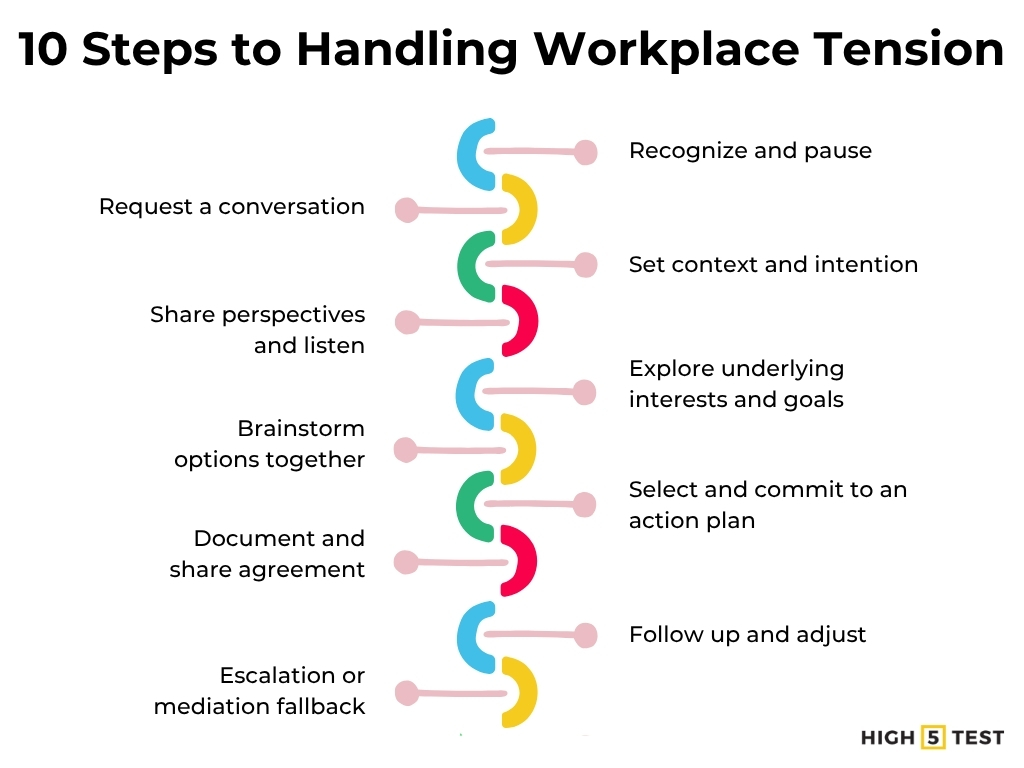
1. Recognize and pause
Notice when tension is present. Step back if emotions feel intense.
2. Request a conversation
Say, “Could we set a time to discuss something? I’d like to get back in sync.” Choose a suitable format like face-to-face, video, or hybrid.
3. Set context and intention
Begin with shared purpose: “I believe we both care about X.” Agree on how the conversation will be handled.
4. Share perspectives and listen
Each shares observations, feelings, and needs without interruption.
5. Explore underlying interests and goals
Ask questions like: “What matters most to you here?” Find areas of alignment.
6. Brainstorm options together
Generate multiple paths without judging.
7. Select and commit to an action plan
Be precise: who does what by when. Define what success looks like.
8. Document and share agreement
Write a neutral summary and share it with both parties.
9. Follow up and adjust
Check in at agreed-upon times and revisit any unresolved points.
10. Escalation or mediation fallback
If progress stalls, bring in a neutral third party to help move things forward.
How HIGH5 supports conflict resolution
HIGH5 is a strengths-based personality and team assessment. It helps individuals and teams identify their top strengths and understand how these interact in a group setting. The test shows how team members typically approach work, communication, and stress.
It highlights blind spots, overlapping tendencies, and complementary styles. It also provides teams with a shared language to understand differences better and identify potential triggers for conflict in advance. To see practical ways to apply this in your own team, see How To Use a Personality Test for Teams and Team Building.
Ways to use HIGH5 in conflict resolution
- Early on: Use HIGH5 with new teams or during restructuring to set a foundation.
- After conflict: Review team and individual reports to guide constructive conversation.
- In dialogue: Try saying, “Your HIGH5 strength is X. From that perspective, what’s most important to you right now?”
- To prevent issues: Align roles and assign tasks based on strengths. This can lower friction and improve collaboration.
Best practices, pitfalls, and leadership roles
Strong team dynamics rely on consistent communication, early intervention, and clear standards. Remote and hybrid environments can magnify tensions if left unaddressed. This section outlines what leaders and teams can do to maintain healthy collaboration.
Setting expectations and working agreements
- Set clear expectations around roles, responsibilities, and workflows.
- Use regular check-ins to surface tension early.
- Encourage open feedback and make disagreement acceptable within team culture.
- Define escalation paths and shared norms for respectful discussion.
- Create space to revisit and adjust practices as teams evolve.
Common pitfalls and warning signs
- Delaying action on small tensions can escalate the issue.
- Framing issues as personal flaws or character problems can derail resolution.
- Jumping to solutions before understanding the full picture risks missing root causes.
- Avoid handling emotional or sensitive topics over email or chat.
- Inconsistent handling of conflict can lead to perceptions of favoritism or unfairness.
Leadership and managerial action
- Model openness. Share your own mistakes to lower defensiveness.
- Coach participants through conflict rather than imposing fixes.
- Step in early with a neutral stance when tension builds.
- Use structured workshops or facilitated discussions when issues repeat.
- Track participation patterns. If someone speaks less or withdraws, check in privately.
Conclusion
Conflict with a co-worker doesn’t have to derail team performance. With the right mindset, clear process, and practical tools, friction can strengthen working relationships. This applies across onsite, hybrid, and remote settings. Addressing tension early, aligning on goals, and making space for honest dialogue builds trust and improves collaboration. The aim is not to eliminate disagreement, but to manage it in a way that makes the team more resilient.