Choosing a leadership assessment test is a high-impact decision. Organizations rely on these tools for hiring managers, preparing successors, and supporting leader growth. With many options available, clarity matters more than brand names. This guide explains how to select a leadership assessment tool using clear criteria and sound evidence.

Why assessment quality affects outcomes
Leadership assessments influence hiring, promotion, and development decisions. A well-chosen tool improves accuracy beyond interviews alone. It supports better coaching conversations and clearer development plans. It also reduces costly hiring errors.
On the flip side, a poorly chosen tool can generate vague or misleading results, encourage bias, and misrepresent a leader’s true potential. Time and budget are spent on data that doesn’t translate into better decisions. That’s why selecting a leadership assessment is a business decision that affects performance, engagement, and retention.
1. Define the purpose of the assessment
Before reviewing tools, clarify why you are assessing leaders. Typically, leadership assessments support one or more of these purposes:
- Hiring and selection – to predict job performance and reduce hiring mistakes
- Leadership development – to build self-awareness, guide coaching, and tailor training
- Succession planning – to identify high-potential leaders and plan future talent moves
For hiring, prioritize tools that have strong predictive validity, such as cognitive ability assessments combined with validated personality tests. For development, strengths-based tools and 360-degree feedback often create more engagement and buy-in.
Succession planning usually benefits from a blended approach that integrates traits, motivation, cognitive style, and observed behavior.
If you skip this step and jump straight to picking a brand-name tool, you risk paying for impressive reports that don’t actually move the needle on your real goals.
2. Choose the right assessment type
Different tools reveal different aspects of leadership. Knowing the main categories helps you choose wisely.
- Personality and trait assessments – These focus on traits and natural tendencies. They help explain energy drivers and stress points.
- Behavioral assessments – These simulate work scenarios and show how leaders act under pressure or ambiguity.
- 360-degree feedback tools – These collect input from peers, managers, and direct reports. They provide context-rich insight into day-to-day leadership behavior.
- Cognitive ability assessments – These measure reasoning, problem-solving, and learning speed. They are strong indicators of performance in complex leadership roles.
Most organizations combine tools rather than relying on one alone.
3. Review reliability and validity
A leadership assessment is only as trustworthy as the science behind it. Two key concepts matter here: reliability and validity.
Reliability refers to the consistency of results. If a leader takes the test twice under similar conditions, their core scores should remain relatively stable. Look for internal consistency and test–retest reliability information in the technical manual or on the provider’s website.
Validity determines whether the tool measures what it claims to measure. For leadership assessment, the most important types are construct validity (does it really assess the trait or competency it says it does?) and predictive validity (do scores correlate with actual job performance or leadership outcomes?). If a provider cannot offer evidence of validation studies, treat that as a red flag.
Choosing tools without proper psychometric backing can introduce bias and lead to unfair or inaccurate decisions, especially in hiring and promotion contexts.
4. Examine reporting and insight quality
Reports vary widely in usefulness. Some sound impressive but offer little guidance. Strong reports explain results in plain language.
When reviewing sample reports, ask yourself:
- Does the report highlight a leader’s key strengths and risk areas in plain language?
- Are there specific, actionable recommendations rather than abstract labels?
- Is the link between scores and real-world behavior explained clearly?
- Can managers and HR professionals interpret the results without a psychologist sitting next to them?
The best leadership assessments turn raw scores into development roadmaps: focused behaviors to practice, conversations to have, and habits to build. Reports that can be aggregated at the team or organizational level are a bonus, as they help you understand broader leadership strengths and weaknesses.
5. Consider user experience and rollout
A technically brilliant assessment that leaders hate taking won’t help you. User experience can make or break adoption.
Pay attention to practical factors such as test length, instruction clarity, and whether the interface is modern and user-friendly. Leaders are more likely to complete the assessment honestly and thoughtfully if it feels intuitive and respectful of their time. Mobile compatibility is important, especially for distributed or field-based teams.
Implementation also matters. Check if the tool integrates with your existing HR systems, such as your HRIS, ATS, or learning platform. Ask about administrator dashboards, data exports, and the level of onboarding support. Strong onboarding support reduces friction. Data should support decisions, not sit unused in files.
6. Compare cost and scalability
Leadership assessment tools can range from free or low-cost questionnaires to sophisticated enterprise solutions. To avoid surprises, look beyond the headline price and consider how your usage might grow over time.
Compare models such as:
- Pay-per-assessment
- Bundled credits for a certain volume
- Annual or multi-year licenses
- Enterprise-wide unlimited access
Indirect costs add up. These may include facilitator training, coaching services, and system integration.
The best option matches your rollout plan. Short programs differ from organization-wide initiatives.
7. Check cultural and global fit
Global teams need culturally aware tools. Assessments built for one region may not translate well.
Look for tools that:
- Have multiple language options
- Have been tested for cultural and gender bias
- Offer local norms or regional benchmarks
A culturally aware assessment helps avoid misinterpretations and supports fair, inclusive evaluation across your global talent pool.
8. Pilot the assessment before full rollout
Piloting is your chance to “try before you buy” at scale. Select a small but representative group of leaders and ask them to complete the assessment, then gather both quantitative and qualitative feedback.
During the pilot, focus on:
- Ease of use and clarity of instructions
- Perceived accuracy of the results
- Usefulness of the report for self-reflection and development
- Fit with your competency model and leadership culture
If possible, compare two different tools side by side. You may find that one is more engaging or more aligned with your values and leadership style, even if both are technically sound. The pilot ensures you’re not making a large investment based on marketing materials alone.
Top leadership assessment tools and when to use them
There is no single “best” leadership assessment for every situation; it depends on your goals. But it helps to understand some common options and their sweet spots.
1. Strengths-based assessment
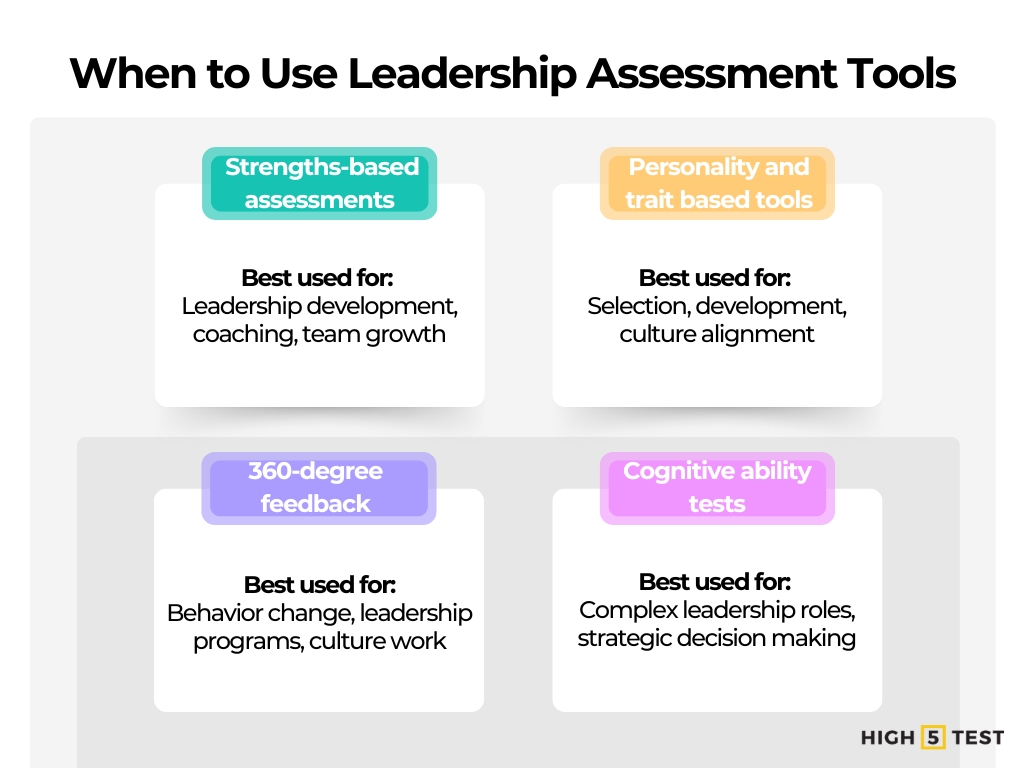
Strengths-based tools like the HIGH5 Strengths Test or CliftonStrengths are particularly effective for development and coaching. They highlight what leaders naturally do best and how those strengths can be applied in their roles.
2. Personality and trait-based tools
Tools such as Hogan or Big Five/NEO-PI instruments are well-suited for both selection and development, especially where you want to understand leadership style, potential derailers, and culture fit.
3. 360-degree feedback assessments
These assessments support behavior change and values alignment. They are often used in leadership programs, coaching, or cultural transformation initiatives.
4. Cognitive ability tests
Tests such as Watson-Glaser or SHL cognitive batteries are most valuable for roles where complex problem-solving, analysis, and strategic thinking are central to success.
In many organizations, the most effective approach combines these categories. For example, using a personality assessment and cognitive test for selection, then adding a strengths-based or 360 tool for development.
Making the final decision
When you reach the short-list stage, decision-making becomes more about alignment than about features. Ask yourself:
- Does this tool clearly map to our leadership competencies and values?
- Is there credible evidence of reliability and validity?
- Do the reports provide clear, actionable insights for leaders and managers?
- Is the user experience strong enough to ensure high participation and honest responses?
- Can we afford it at the scale we need now and in the future?
- Does it support our global footprint and diversity goals?
The right leadership assessment tool should make it easier for you to spot potential, guide development, and make fair, data-informed decisions. If a tool looks impressive but doesn’t help you do those things, it may not be the right fit, no matter how strong the branding.
Common questions about leadership tests
What is the most accurate leadership assessment?
Accuracy depends on research quality and context fit. Tools based on well-studied models perform consistently when aligned with role demands.
How do I choose a leadership test for managers?
Start by defining the core competencies you expect from your managers, such as people leadership, communication, and decision-making. Then select assessments validated to measure those competencies, and pilot them with a small group before rolling them out more widely.
What tools help identify leadership potential?
Strengths-based assessments, cognitive ability tests, and behavioral simulations are particularly useful for spotting high-potential leaders. Combined, they give you a view of both what a person is naturally good at and how they perform in challenging situations.
What is the difference between a personality test and a leadership test?
Personality tests measure relatively stable traits, such as extraversion or conscientiousness, while leadership tests focus on behaviors and competencies, often in work-related scenarios. Many leadership assessments actually incorporate personality data, but interpret it through a leadership view.
Do leadership assessments predict job performance?
Validated leadership assessments can significantly improve the prediction of job performance, especially when they measure traits and abilities proven to correlate with leadership success. The impact is strongest when assessments are combined with structured interviews and clear competency frameworks.
Conclusion
Choosing the right leadership assessment test is both strategic and scientific. When you’re clear on your purpose, focused on the right competencies, and selective about tools with strong evidence and practical reporting, assessments become a powerful lever, not just for evaluating leaders, but for helping them grow. With the right tool in place, you can build a more capable, confident, and future-ready leadership bench.
Start leadership development with HIGH5
If your goal is leadership development, coaching, or succession planning, the HIGH5 Strengths Test is a strong option to consider. It focuses on what leaders do naturally well and how those strengths show up at work. The results are easy to understand and practical to apply in real conversations. Take the HIGH5 Strengths Test to see how it can support your leadership assessment strategy and help leaders grow with clarity and focus.