A leadership assessment is a structured evaluation of leadership behavior, skills, and potential. Organizations use assessments to identify strengths, assess decision-making patterns, and support leadership development, coaching, and succession planning.

Why organizations assess leaders
Work environments change quickly. Leaders manage remote teams, shifting priorities, and higher expectations. Many organizations still depend on intuition for leadership decisions. That approach leads to mismatched promotions and disengaged teams.
Leadership assessments provide structured insight. They replace opinion with observable behavior. Clear data helps leaders grow and helps organizations make better decisions.
What is a leadership assessment?
A leadership assessment evaluates how a person leads others toward shared goals. It reviews behavior, preferences, and patterns that influence leadership outcomes.
Organizations use leadership assessments for:
- Hiring and promotion decisions
- Leadership development programs
- Succession planning
- Team-building
- Coaching and self-awareness
The goal is simple: provide clear insights into leadership capability and future leadership potential.
What leadership assessments measure
Leadership assessments examine behavior that predicts performance in real work settings. They focus on how leaders think, decide, and interact with others.
Core leadership competencies
These are essential, observable behaviors linked to effective leadership:
- Communication and active listening
- Strategic thinking
- Decision-making
- Problem-solving
- Conflict resolution
- Accountability
- Emotional intelligence (EQ)
Behavioral and personality traits
This includes motivations, stress responses, interpersonal tendencies, and blind spots. The goal is pattern awareness rather than labeling.
Common dimensions assessed:
- Influence and persuasion
- Collaboration vs. independence
- Risk-taking
- Adaptability
- Assertiveness
- Integrity
Leadership potential indicators
High-potential leaders typically demonstrate:
- Learning agility
- Situational awareness
- Self-awareness
- Growth mindset
- Ability to inspire others
Level-specific leadership competencies
Different leadership levels require different qualities:
- New managers: delegation, communication, clarity
- Middle managers: cross-functional collaboration
- Executives: vision, strategy, organizational impact
5 types of leadership assessments
Organizations often combine multiple assessment types for better insight.
1. Personality-based leadership assessments
These tests measure traits and preferences that shape leadership behavior.
Examples:
- HIGH5 Strengths Test
- Big Five
- DISC
- MBTI (used widely but not predictive)
They support self-awareness and team communication.
2. Behavioral leadership assessments
Behavioral tools assess how leaders respond to realistic situations.
Examples:
- Situational Judgment Tests (SJTs)
- Leadership case studies
- Simulations and role plays
Useful for predicting leadership performance.
3. 360-degree leadership assessments
The 360-degree leadership assessments combine feedback from managers, peers, direct reports, and self-reflection.
Benefits:
- Holistic perspective
- Reveals blind spots
- Great for coaching programs
4. Cognitive and decision-making assessments
Measure analytical thinking, problem-solving, and reasoning.
5. Strengths-based leadership assessments
Tools like HIGH5 focus on what individuals naturally do best.
Benefits:
- Higher engagement
- Better team collaboration
- Sustainable development strategies
Benefits of leadership assessments
Leadership assessments support better decisions at both organizational and individual levels.
Organizational benefits
Organizations improve hiring accuracy, reduce turnover, strengthen leadership pipelines, improve engagement, and support consistent leadership standards.
Individual benefits
Leaders gain clarity, confidence, communication insight, and a clear development focus.
How to choose the right leadership assessment
When choosing the right leadership assessments, they should match purpose, show research backing, provide practical insight, scale across teams, and support a strengths-focused approach.
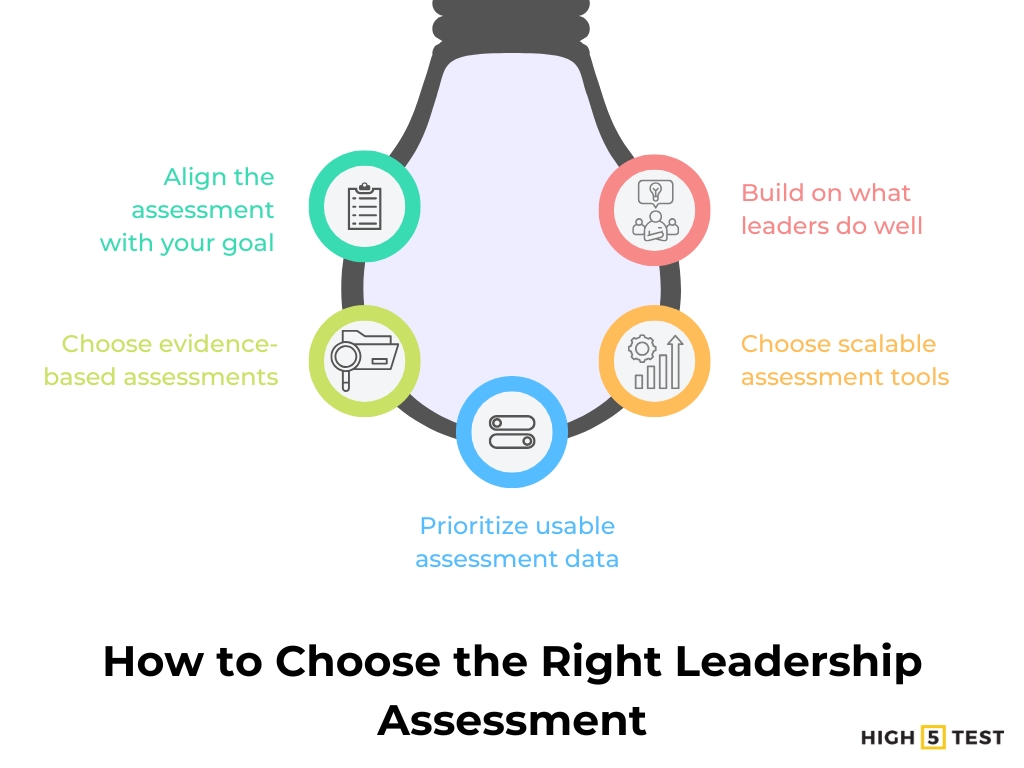
Fit for purpose
Is it for hiring, development, coaching, or succession planning?
Scientific validity
Look for assessments based on psychology, validated constructs, and reliability.
Actionability of results
Good assessments translate insights into practical next steps.
Scalability
Works for individuals, teams, and entire organizations.
Strengths-based vs deficit-based
Strengths-based assessments (HIGH5) tend to drive longer-term change.
Leadership development with HIGH5
Leaders who apply strengths daily show higher engagement and resilience. HIGH5 measures natural strengths, leadership style patterns, interpersonal behavior, and motivation preferences.
Organizations apply HIGH5 in onboarding, leadership programs, team workshops, coaching, conflict resolution, and succession planning.
How organizations use HIGH5
- Onboarding new managers
- Team workshops
- Leadership academies
- Performance management
- Conflict resolution
- Succession planning
Limitations of leadership assessments
Leadership assessments offer useful insight, yet no tool gives a complete picture. Awareness of their limits helps teams apply results with care and sound judgment. Clear context leads to better decisions and more realistic expectations.
1. Leadership behavior can be simplified too much
Leadership is shaped by experience, culture, pressure, and team dynamics. Most assessments focus on patterns, not full situations. Results describe tendencies rather than fixed behavior. Real-world leadership still changes based on context.
2. Results can be misread or applied incorrectly
Assessment data needs thoughtful interpretation. Results without context can lead to inaccurate labels or narrow conclusions. Decisions around hiring or promotion should combine assessment insight with observation and conversation.
Common misuse examples
- Treating scores as fixed traits
- Ignoring situational factors
- Relying on reports without discussion
Tools are helpful, but human judgment is still essential.
3. Some tools lack research support
Assessment quality varies widely. Some tools rely on outdated models or weak data. Poor design leads to inconsistent results and false confidence. Research-backed tools provide more dependable insight.
4. Test responses may reflect intent, not behavior
In high-stakes situations (e.g., promotions or executive hiring), individuals may answer how they think the employer wants them to. This limits accuracy, especially in promotion or executive selection processes.
Who should take a leadership assessment?
Leadership assessments support new managers, senior leaders, high-potential employees, founders, coaches, consultants, and intact teams.
When to use leadership assessments?
- During hiring and promotion decisions
- Leadership training programs
- Team-building initiatives
- Coaching sessions
- Succession and talent planning
- Performance reviews
- Conflict management situations
Common leadership assessment questions
What does a leadership assessment include?
Assessments may include personality tools, behavioral scenarios, competency reviews, and feedback from others.
How do I pass a leadership assessment test?
You don’t pass or fail a leadership assessment. The goal is to reveal how you naturally lead. Answer honestly, stay consistent, and think through scenario-based questions logically. Reviewing your strengths and reflecting on past leadership experiences helps you present your authentic leadership style.
How often should leadership assessments be conducted?
Leadership assessments should be conducted annually for development and every 18–24 months for succession planning. Regular reassessment helps track growth, adapt development plans, and ensure leadership competencies stay aligned with evolving organizational needs and team dynamics.
Conclusion
Leadership assessments support clarity, consistency, and growth. They help leaders understand their natural strengths and guide focused development. A structured, strengths-based assessment provides a practical starting point for better leadership decisions and sustained performance.
Organizations that apply leadership assessment results with coaching and follow-up see stronger alignment, better engagement, and more consistent leadership standards. The assessment becomes a practical tool for progress rather than a static report.
Take the next step with HIGH5
HIGH5 offers a strengths-based leadership assessment that delivers clear, practical insight leaders can use right away. The assessment is research-backed, easy to apply, and suitable for individuals, teams, and organizations.
Start with the free HIGH5 assessment today and support leadership growth with clarity, focus, and purpose.