At a glance:
To conduct a leadership assessment, start by defining the leadership capabilities you want to measure. Select a validated leadership assessment tool and explain the process clearly to participants. Administer the assessment, collect feedback from multiple sources, and review the results. Use the insights to create a strengths-based development plan. Tools such as the HIGH5 Leadership Assessment support objective insights and practical development actions.

Introduction
Leadership capability strongly influences team performance, retention, and long-term results. Many organizations still rely on personal opinions or informal feedback. This limits accuracy and consistency.
A structured leadership assessment brings clarity and fairness. Strengths-based tools such as the HIGH5 Leadership Assessment focus on observable behavior and natural talent. Leaders can apply the results directly to daily work.
This guide explains how to run a leadership assessment from start to finish. It covers preparation, execution, and follow-up.
What is a leadership assessment?
A leadership assessment is a structured evaluation of how a person leads, influences, and supports others toward shared goals. It focuses on behavior rather than opinion. These assessments typically examine:
- Communication
- Decision-making
- Emotional intelligence
- Problem-solving
- Team leadership
- Accountability
- Strategic thinking
- Ability to inspire others
Leadership assessments generate actionable insights for development, hiring, promotion, succession planning, and building high-performing teams.
Common types of leadership assessments
Organizations use several assessment formats. Each serves a different purpose.
- Strengths-based assessments – highlight natural talents.
- 360-degree leadership feedback – collects input from managers, peers, and reports.
- Situational judgment tests (SJTs) – measure decision responses.
- Behavioral and competency-based assessments – review observable actions.
- Leadership simulations or role plays – test leadership behavior in real time.
- Personality assessments – provide additional context.
Strengths-based tools lead to higher engagement and faster development by identifying what leaders naturally do best.
Benefits of conducting a leadership assessment
A leadership assessment provides value at both the individual and organizational levels. It creates a shared language around leadership behavior and supports consistent decision-making. The benefits extend beyond development and influence engagement, retention, and long-term performance. The most common outcomes are outlined below.
1. Better promotion and leadership selection
Objective insights help avoid bias and identify true leadership potential.
2. Stronger leader development
Strengths-focused development supports faster and more sustainable growth.
3. Higher team engagement and morale
Leaders who operate from their strengths create healthier, more motivated teams.
4. Clear leadership pipelines
Assessments show readiness for expanded responsibility.
5. Greater self-awareness
Leaders gain clarity about their behaviors, tendencies, and impact on others.
6. Reduced turnover and leadership bottlenecks
Leaders who fit their roles tend to stay longer and perform better.
What makes HIGH5 different
HIGH5 uses a strengths-based framework grounded in positive psychology. It avoids negative labels and focuses on practical behavior. The tool works for individuals, teams, and organizations. A free version is available.
When to conduct a leadership assessment
Leadership assessments are useful during promotions, role changes, team restructuring, and leadership training programs. They also support:
- Annual performance reviews
- Succession planning initiatives
- Conflict resolution efforts
- Early identification of high-potential talent
Any situation that requires leadership clarity can benefit from assessment data.
How to conduct a leadership assessment (Step-by-step process)
This is the core section designed to rank for how to conduct a leadership assessment.
Step 1: Define the purpose and scope
Clarify why the assessment is taking place. Decide which leadership behaviors matter most. Identify the target group and intended use of the data. Clear intent guides tool selection and communication.
Add a leadership competency model
Consider defining competencies such as:
- Vision and strategy
- Communication
- Collaboration
- Decision-making
- Conflict resolution
- Emotional intelligence
- Execution and accountability
HIGH5 strengths map naturally onto these competencies, making interpretation simpler.
Step 2: Select the right assessment tool
Choose a tool that is validated, behavior-based, strengths-focused, easy to use, and scalable. Insights should translate into action.
HIGH5 meets these criteria. It uses clear language, requires limited time, applies to all leadership levels, and avoids negative scoring. It can be combined with 360-degree feedback for broader insight.
Step 3: Communicate the process clearly
Explain the purpose, timing, data use, and follow-up steps. Confirm who will see the results. Clear communication increases participation and data quality.
Step 4: Administer the assessment
Provide clear instructions and deadlines. Encourage a quiet environment with minimal interruptions. The HIGH5 Leadership Assessment is digital and works on any device.
Step 5: Gather additional data
A strong leadership assessment uses multiple data sources, not just one tool.
Recommended inputs:
- Manager feedback
- Peer reviews
- Self-assessment worksheets
- KPI performance data
- Stakeholder feedback
- Behavioral observations
- 360 leadership feedback cycles
This creates a more comprehensive “leadership capability profile.”
Step 6: Review and interpret results
Once all data is collected, identify key strengths, behavior patterns, and development areas. Compare self-perception with external feedback. Group insights into themes.
HIGH5 reports include themes of strength, leadership style indicators, behavioral patterns, and development suggestions.
Step 7: Create a leadership development plan
Focus on two to four core strengths. Add a small number of growth areas.
Your plan should include:
- SMART goals
- Real-world practices to apply
- A timeline (30/60/90 days or quarterly)
- Success metrics
Example development goal
- Goal: Improve decision-making speed
- Strength leveraged: Strategist
- Action: Use a weekly rapid-decision framework
- Timeline: 3 months
- Measurement: Reduced delays in project approvals
HIGH5 provides strengths-based development tips tailored to each individual’s results.
Step 8: Share results through a debrief
A 30–60-minute coaching conversation helps turn insights into action.
In the debrief:
- Start with strengths
- Review assessment results together
- Connect results to real work situations
- Discuss surprises or blind spots
- Agree on development goals
- Identify strengths to use more intentionally
This builds trust, motivation, and ownership.
Step 9: Track progress and reassess
Leadership growth requires follow-up. Use regular check-ins, feedback, and performance indicators. Reassessment every six to twelve months shows progress over time.
Leadership assessment example (Template + walkthrough)
Example leader profile:
- Top Strengths: Strategist, Coach, Empathizer, Deliverer, Optimist
- Leadership Style: Vision-oriented and people-centered
- Behavioral Tendencies: Mentors others, simplifies complexity, builds trust
Mapped competencies
| Competency | Strength | Behavior |
| Communication | Empathizer | Creates space for open dialogue |
| Strategic thinking | Strategist | Identifies patterns and long-term opportunities |
| Team development | Coach | Helps others grow intentionally |
| Execution | Deliverer | Ensures commitments are met |
Common mistakes to avoid
Even well-planned leadership assessments can fall short without the right approach. Certain missteps reduce trust, limit insight, or stop progress after results are shared. Awareness of these common issues helps ensure the assessment leads to meaningful development rather than unused data.
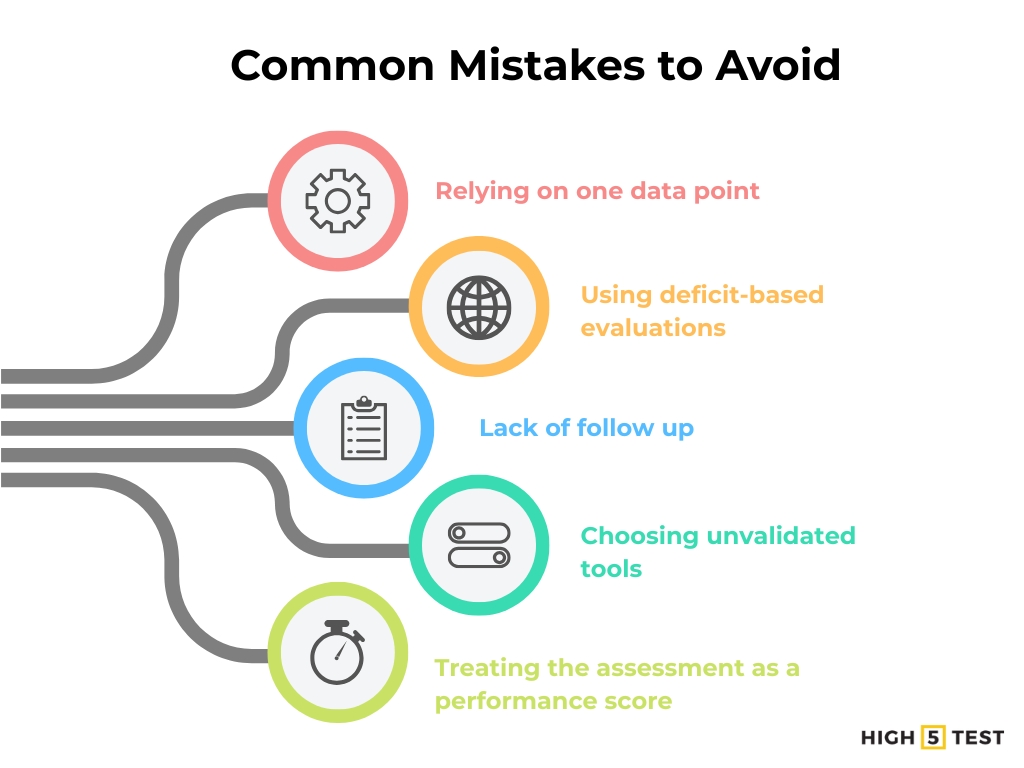
1. Relying on one data point
A single assessment rarely provides enough context.
2. Using deficit-based evaluations
This lowers morale and inhibits growth.
3. Lack of follow-up
Insights without coaching = no real change.
4. Choosing unvalidated tools
Stick to scientifically grounded methods.
5. Treating the assessment as a performance score
Leadership assessments are developmental, not judgmental tools.
HIGH5 leadership assessment overview
The HIGH5 Leadership Assessment identifies natural strengths and leadership behavior patterns. It supports individual growth, coaching, and team development. Results are practical and easy to interpret.
Why organizations use HIGH5
- Fast, modern, and science-based
- Accessible for all levels of leadership
- Actionable, easy-to-interpret results
- Ideal for leadership programs, coaching, and team development
FAQs about conducting a leadership assessment
What makes a good leadership assessment?
A strong leadership assessment is grounded in research and focuses on observable behavior. It provides clear insights that leaders can apply in their daily work. The results should support development rather than ranking or judgment.
How long does it take?
Most leadership assessments take between 15 and 45 minutes to complete. The exact time depends on the tool and the number of added feedback sources. Shorter assessments often improve completion rates without reducing insight.
Can you use leadership assessments for hiring?
Leadership assessments can support hiring when combined with interviews and performance-based methods. They should never be the sole decision factor. Ethical use requires transparency and consistent application across candidates.
What if a leader receives unexpected or low results?
Strengths-based assessments do not assign negative scores. Results highlight patterns and development opportunities. Coaching and follow-up conversations help leaders interpret feedback constructively and plan next steps.
How do I run this for a full team?
Scalable tools provide individual and team reports without adding complexity. Team-level insights show shared strengths and gaps. This supports targeted development and alignment across groups.
Conclusion
Conducting a leadership assessment is no longer limited to routine HR activity. It is a strategic advantage for organizations that want clarity, consistency, and direction across leadership levels. Strong assessments replace guesswork with observable behavior and reliable data.
A structured, strengths-based approach helps leaders see how they lead and where their natural talents show up at work. Clear insight supports better development conversations and more focused growth actions. Combined with coaching, feedback, and follow-up, leadership assessments support engagement, performance, and long-term progress.
Take the next step with HIGH5
Start your leadership assessment with HIGH5 today and build leaders who perform, engage, and grow with intention.
Key benefits include
- Fast and simple deployment
- Strengths-based and positively framed results
- Clear insights for individuals, teams, and organizations
- A free version to help you start quickly