Have you ever fixated on past mistakes and struggled with negative self-talk? As a survival mechanism, the human brain is hardwired to focus on the negative as a means of minimizing risk. Unfortunately, these tendencies can have a major impact on the way we think and act. Though remembering our mistakes is essential to learning, when left unchecked, this “negativity bias” can undermine our most productive behavior in relationships and at work. Understanding your strengths can balance your perspective and help you leverage your strengths so that you will be more highly equipped to meet goals and avoid errors. Most people relate to many strengths – the hard part is identifying the 5 that truly drive you.
This article will explore personal strengths at a high level and guide you through identifying your own unique strengths using the HIGH5 test. Finally, we will offer guidance on how to leverage your strengths, ensuring the full application of your abilities within your career.
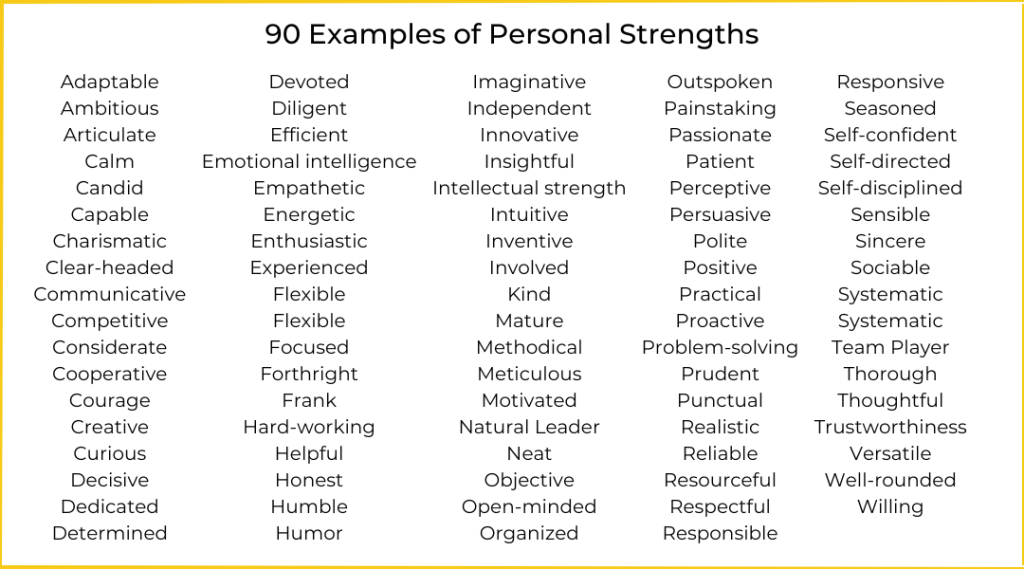
90 examples of personal strengths
Most people can see themselves in dozens of strengths – so simply reading a list won’t tell you which ones truly drive your motivation and energy.
The goal isn’t to “pick your favorites,” but to identify the strengths that show up consistently across situations. If you want help narrowing this down, the free HIGH5 test can identify your top 5.
You’ll find the full list below, then you can take the test to get your Top 5.
- Adaptable
- Ambitious
- Articulate
- Calm
- Candid
- Capable
- Charismatic
- Clear-headed
- Communicative
- Competitive
- Considerate
- Cooperative
- Courage
- Creative
- Curious
- Decisive
- Dedicated
- Determined
- Devoted
- Diligent
- Efficient
- Emotional intelligence
- Empathetic
- Energetic
- Enthusiastic
- Experienced
- Flexible
- Focused
- Forthright
- Frank
- Hard-working
- Helpful
- Honest
- Humble
- Humor
- Imaginative
- Independent
- Innovative
- Insightful
- Intellectual strength
- Intuitive
- Inventive
- Involved
- Kind
- Mature
- Methodical
- Meticulous
- Motivated
- Natural Leader
- Neat
- Objective
- Open-minded
- Organized
- Outspoken
- Painstaking
- Passionate
- Patient
- Perceptive
- Persuasive
- Polite
- Positive
- Practical
- Pragmatic
- Proactive
- Problem-solving
- Prudent
- Punctual
- Realistic
- Reliable
- Resourceful
- Respectful
- Responsible
- Responsive
- Seasoned
- Self-confident
- Self-directed
- Self-disciplined
- Self-motivated
- Self-aware
- Sensible
- Sincere
- Sociable
- Systematic
- Team player
- Thorough
- Thoughtful
- Trustworthiness
- Versatile
- Well-rounded
- Willing
What are personal strengths?
All people are born with unique gifts or “aptitudes.” An aptitude is a natural, innate ability that lends itself to the development of skill. For example, a person who naturally harbors a fast reaction time, good hand-eye coordination, excellent balance, and accurate depth perception likely has a high aptitude for athletics, even if that person does not know how to play a sport. Once these aptitudes are identified, they can be honed through practice until they become a skill. Personal strengths are developed aptitudes that allow a person to master and demonstrate a particular skill. If you want to identify your strengths (not just read about them), take the free HIGH5 test.
There has been much buzz on personal strengths in the field of positive psychology, the study of human thriving and well-being. But what is the relationship between positive psychology and strengths? One leadership approach that has arisen out of positive psychology is the strengths-based leadership approach. This approach maintains that individuals, teams, and organizations perform at higher rates of success and engagement when leaders focus on the development of strengths, rather than compensation for or development of weaknesses.
Positive psychology maintains that the intentional development and meaningful application of strengths enhance well-being and human flourishing. Dr. Martin Seligman, one of the founders of positive psychology, maintains that to be truly happy, one must be aware and use their “most fundamental strengths” and use them in daily life.
What are personal weaknesses? Definition
Positive psychology and strength-based leadership caution against an over-emphasis on deficits in people and systems. Whereas other leadership approaches often focus on the question, “What’s wrong?” strength-based leadership asks, “What’s possible?” Business visionary Peter Drucker summarized this approach well when he said, “The task of leadership is to create an alignment of strengths in ways that make a system’s weaknesses irrelevant.”
A helpful way to think about “weaknesses” is that they’re often the overuse or misapplication of a strength – for example, decisiveness can become impatience, and thoroughness can become perfectionism.
That’s why identifying your top 5 is only step one: the real value comes from knowing how to apply them well and what to watch for when you’re under stress. The Personal Strengths Report ($29) goes deeper into watch-outs and practical development strategies tied to your results.
Benefits of discovering your strengths
Understanding your strengths and weaknesses is a powerful starting point—but the real benefit comes from knowing which strengths are truly most natural for you and how to apply them. The HIGH5 test helps you identify your top 5 strengths so you can turn self-awareness into practical next steps in your personal life, career, or studies.
Several studies back up the benefits of exploration and knowledge of an individual’s strengths. Below are some studies that show how knowing one’s strengths has a positive impact on a person’s life.
- A literature review on the use of strengths in organizations found that the intentional application of strengths has led to improved well-being, work engagement, work performance, and job satisfaction in the workplace.
- A character strengths-based program incorporated into the curriculum of adolescent students led to a significant increase in their life satisfaction and well-being. A similar study conducted on undergraduates found that awareness of strengths led to improved measures of well-being, happiness, and health and a decrease in negative emotions and loneliness.
- One study found that understanding of strengths improved student well-being and is positively correlated to academic achievement. In the same vein, college students who know their strengths and capitalize on them will use social support and create successful experiences that provide them with opportunities to use their strengths in novel situations.
- Numerous studies found that a strengths-based approach to client care and management improves not only health professionals’ service towards patients but also leads to more positive relationships between clients and their caregivers.
- Therapists and counselors help their clients discover their strengths and utilize them in the therapeutic process to facilitate growth.
1. Greater Self-Knowledge
Knowing yourself and your weaknesses and strengths helps you identify the types of situations and tasks in which you are likely to excel. Conversely, this self-knowledge will also help you identify tasks and situations in which you are likely to face difficulty. This knowledge enables you to more accurately identify the roles and responsibilities that will likely pose a challenge to you. This is especially useful when choosing roles, majors, projects, or environments where you’ll naturally perform and feel energized.
2. Recognition of growth opportunities
Self-improvement begins with self-awareness. Knowing your strengths and weaknesses provides an opportunity to decide which aptitudes you might wish to develop into skills. Through positive psychology and strength-based leadership, do not focus on weaknesses; you may identify weaknesses that you do wish to develop and improve. The choice is yours! In practice, this helps you pick development goals that match your strengths – whether that’s leadership skills, study habits, or communication in relationships.
3. Improves self-confidence
Many people live their lives unaware of their innate strengths and gifts. An awareness of the strengths that make you unique can improve your self-esteem and self-efficacy in work and life. It can also make it easier to talk about your strengths in interviews, performance reviews, or university applications.
4. Heightens appreciation for differences
Often, we assume that the people around us are like us, when in reality, each person is unique in their strengths, drivers, preferences, and personality traits. The more we work with people who have different strengths, the more we can come to appreciate the value of differences in others. This is valuable in teams and group work because it helps you understand why others contribute differently – and how to collaborate better.
5. Improves self-esteem
Everyone has quirks and idiosyncrasies. While we may dismiss them as “weird traits,” they could be related to your strengths. Acknowledgment of strengths in relation to what may seem like an arbitrary trait can improve self-esteem. When you can name what you’re naturally good at (and what to watch for), you build a more balanced, resilient self-view.
If you want to pinpoint your top 5 strengths (instead of guessing from a list), you can take the free HIGH5 test.
Tips for identifying your character strengths
If you’ve ever been asked about your strengths in an interview, performance review, or application, you know the hard part isn’t finding examples – it’s choosing the strengths that are truly most natural for you. Use the steps below to identify strengths you consistently show across situations, then validate your top 5 with the free HIGH5 test.
Knowledge-based skills
These are strengths you’ve built through learning and experience (tools, methods, domain knowledge). Ask: “What can I do well because I’ve practiced it – and would I still enjoy it if no one rewarded me for it?”
Soft skills
These are strengths that show up across roles (problem-solving, communication, leadership). Ask: “What do people repeatedly come to me for – regardless of the job I’m in?”
Personal skills
These are strengths that shape how you relate and operate (empathy, adaptability, discipline). Ask: “What energizes me even when I’m tired – and what drains me even when I’m capable?”
Ways to identify and measure your strengths
There are a few common ways to identify strengths. The best option depends on what you want next: a quick baseline you can apply immediately, deeper character research, or a paid talent profile. If you’re here because you want a practical starting point, the free HIGH5 test is designed to identify your top 5 strengths and help you apply them right away.
HIGH5
HIGH5 is a free strengths assessment built to help you identify what you’re naturally great at—what motivates and energizes you—so you can use those strengths in real situations (work, school, and relationships).
What you get for free: your top 5 strengths (ranked) with their definitions and explanations
Optional next step (after the test): choose a report based on your goal:
- Student Report ($19): academic superpowers, development insights, blind spots, group work/social dynamics guidance, future pathway recommendations
- Personal Report ($29): development strategies, watch-outs, and best complementary partners
- Career Report ($29): matching careers & company cultures, interview & CV tips, how to change careers & bounce back from setbacks
Take the free HIGH5 test to discover your top 5 strengths.
VIA Character
VIA Character Strengths focuses on character traits (24 strengths across 6 virtue clusters). It’s a solid option if you’re primarily interested in character development and values-based strengths.
CliftonStrengths
CliftonStrengths (StrengthsFinder) is a paid assessment that provides a talent profile often used in professional development contexts. It can be a fit if you want a paid, workplace-focused framework and don’t mind paying upfront.
If you want to start now without paying upfront, take the free HIGH5 test to get your top 5 strengths – then decide whether a Personal, Career, or Student report would be most useful.
Step-by-step guide on how to identify personal strengths
Here’s how to get started with HIGH5:
- Start with the list of 90 strengths outlined in this article (optional):
Skim the strengths list above and note 10 that sound most like you. - Take the HIGH5 test (free):
Answer the questions honestly for the most accurate results. The test takes about 15 minutes. - Get your top 5 strengths (free):
Your top 5 strengths are shown after you complete the assessment. You can save your results and access them later. - Apply your strengths (and optionally go deeper):
Use your top 5 to set one small goal this week (work, school, or relationships). If you want more guidance, you can unlock a report after the test:- Personal Report ($29): development strategies, watch-outs, best complementary partners
- Career Report ($29): matching careers/cultures, interview & CV tips, career change & setbacks
- Student Report ($19): academic superpowers, blind spots, group work/social dynamics, future pathways
What are professional strengths?
Professional strengths are the same underlying strengths you have as a person – just expressed in a work context. For example, curiosity becomes fast learning, empathy becomes stakeholder awareness, and organization becomes reliable execution. The goal is to identify the strengths you use consistently so you can communicate them clearly in interviews and performance conversations.
How personal strengths translate at work (examples):
- Communicative → aligns stakeholders, clarifies expectations, prevents rework
- Curious → asks strong questions, learns quickly, spots patterns
- Empathetic → understands people, improves collaboration, reduces conflict
- Decisive → makes timely calls, prioritizes, moves projects forward
- Meticulous → catches errors, raises quality, builds trust
The answers will not always be comfortable. Sometimes people name things you have dismissed as unimportant. That discomfort is often a signal worth paying attention to.
HIGH5 for Professional Development
If you’re using strengths for career decisions, it helps to know not only what your strengths are, but where they fit best – roles, team environments, and company cultures where you’ll perform and feel energized. After you get your top 5 strengths for free, the Career Report ($29) can help you translate them into:
- guidance for career changes and bouncing back from setbacks
- matching careers and company cultures
- interview answers and CV language
Professional strengths in the workplace and for job interviews
In interviews and on your CV, “strengths” matter most when you can back them up with proof. Instead of listing generic traits, identify your Top 5 strengths and prepare 1–2 short stories for each that show impact, context, and results.
Use this 3-part format to describe a strength (in 30–45 seconds):
- Strength (what it is): “One of my strengths is ___.”
- Evidence (proof): “For example, when ___, I ___.”
- Impact (result): “The outcome was ___.”
Examples:
- Problem-solving: “When a process broke, I mapped the root cause, tested two fixes, and reduced turnaround time by 20%.”
- Communicative: “I aligned stakeholders by sending weekly summaries and clarifying ownership—fewer rework cycles.”
- Adaptable: “When priorities shifted mid-project, I reprioritized tasks and kept delivery on track without quality loss.”
Avoid listing strengths with no evidence (e.g., “hard-working, team player”). Hiring managers hear these every day—what stands out is a clear example.
Want interview-ready strengths? Take the free HIGH5 test to discover your top 5, then use the Career Report ($29) for CV wording, interview tips, and matching roles/cultures.
Personal strengths and traits of leaders and managers
Great leaders don’t try to be good at everything – they lead with their natural strengths and build systems (and teams) that complement them. Below are leadership-relevant strength areas, along with how they show up at work and what to watch for when they’re overused.
Communication strengths
At your best:
- Clarify direction and expectations
- Give actionable feedback that moves performance
- Listen actively and reduce misunderstandings
Watch-out (when overused or underused):
- Talking more than listening under stress
- Over-communicating and slowing decisions
- Being so direct it feels blunt
Strengths for providing guidance and direction
At your best:
- Set priorities and align work to outcomes
- Create focus and momentum
- Translate vision into clear next steps
Watch-out:
- Creating vision without execution detail
- Pushing direction without buy-in
- Changing priorities too often
Strengths for supporting staff
At your best:
- Coach people based on their strengths
- Delegate effectively (right person, right task)
- Build psychological safety and motivation
Watch-out:
- Avoiding tough feedback
- Delegating without context
- Over-supporting (rescuing) instead of empowering
Strengths for decision-making and judgment
At your best:
- Make timely, informed decisions
- Balance data with practical constraints
- Take accountability for outcomes
Watch-out:
- Overconfidence / moving too fast
- Ignoring stakeholder impact
- Analysis paralysis (waiting for perfect info)
Organizing and planning strengths
At your best:
- Turn goals into executable plans
- Create clear ownership and timelines
- Anticipate risks and remove blockers early
Watch-out:
- Micromanaging instead of empowering
- Over-planning and delaying action
- Being too rigid when things change
Problem-solving strengths
At your best:
- Spot issues early and address root causes
- Stay calm under pressure
- Facilitate solutions across functions
Watch-out:
- Moving to solutions before alignment
- Fixing everything yourself (bottleneck)
- Treating symptoms instead of root causes
If you want personalized development strategies and watch-outs based on your Top 5 strengths, take the free HIGH5 test – then consider the Personal Strengths Report ($29).
Application of strengths in daily life
Knowing your strengths only matters if you use them. Start by choosing one strength from your top 5 and applying it intentionally in one area this week – work, school, or relationships. Small experiments are the fastest way to turn strengths insight into real change.
A simple weekly strengths plan (10 minutes):
- Pick one strength you want to use more intentionally this week.
- Choose one situation (meeting, studying, difficult conversation, project).
- Define one visible behavior (what you will do differently).
- Review at the end of the week: what worked, what didn’t, and what to adjust.
Examples:
- Student life: If Philomath is your top strength, convert each lecture into 3 questions and answer them from notes—then use one question in class or study group.
- Personal life: If Empathizer is a top strength, ask one deeper question in each important conversation this week—and reflect back what you heard before responding.
- Career: If Strategist is a top strength, start meetings by summarizing the goal, constraints, and the decision needed.
Want a personalized plan for applying your top 5? Start with the free strengths test, then choose the report that fits your goal: Personal ($29), Career ($29), or Student ($19).
Related articles: